

You are standing in front of your first race weekend, and you need a racing suit. You know it matters for safety, but you are unsure what separates a proper FIA racing suit from casual apparel, whether standard sizing will fit your frame, or if your event even requires FIA certification. Club racing sits at the crossroads where safety requirements become real, but the buying decision can still feel overwhelming. This guide walks you through what to check before you buy, so you can show up to the track with gear that meets your event rules, fits your cockpit, and gives you one less thing to worry about on race day.
Choosing the right FIA racing suit for club racing means understanding three core buying priorities: event compliance and certification, fit and coverage in your specific cockpit, and the materials and construction that support both comfort and protection. A suit that looks good in a showroom but does not meet your event rulebook or does not fit your proportions becomes an expensive mistake. This guide focuses on what actually matters when you are comparing options, so you can make a clearer decision before race day.
Quick Buying Advice:
Before you add any FIA racing suit to your cart, check your event rulebook for the specific certification requirement (SFI or FIA rating), validity period, and any labeling requirements. Then measure yourself seated in your racing cockpit, not standing in front of a mirror, to confirm sleeve length, shoulder mobility, and torso fit. Finally, compare standard sizing options against your measurements; custom sizing adds real value only when your proportions fall outside typical size charts or when you need better cockpit comfort for your specific car. This three-step check eliminates most buying mistakes.
- What Should Drivers Know Before Buying an FIA Racing Suit?
- How to Choose Gear Based on Your Racing Discipline
- What Safety Features Should Buyers Check?
- How Fit and Sizing Affect Cockpit Comfort
- Which Materials and Construction Details Matter?
- Standard Size vs Custom Size: Which Should You Choose?
- Final Buying Advice from MotoSpeeds
What Should Drivers Know Before Buying an FIA Racing Suit?
An FIA racing suit is a single- or multi-layer garment designed to slow heat transfer and help reduce burn risk during a racing incident. It is not fireproof, and it does not prevent injury. What it does is provide a tested layer of fire-resistant material between your skin and the cockpit environment, which is why motorsport events require it and why it matters for your safety awareness.
Club racing sits between casual track days and professional motorsport. Your event rulebook will specify whether you need FIA certification, an SFI rating, or both. These certifications indicate that the suit has been tested to a defined standard, but they do not guarantee injury prevention. Protection depends on the correct rating, proper fit, the condition of the material, layering with compatible underlayers and gloves, and the specific racing environment.
The most common beginner mistake is buying a suit without checking the event requirements first. You might purchase a great-looking suit only to arrive at the track and find it does not carry the certification your event requires. Worse, you might buy a suit that fits your street clothes perfectly but binds your shoulders or restricts your steering in the cockpit. Both mistakes are costly and avoidable.
A second mistake is treating all FIA racing suits as interchangeable. A drag racer sitting upright in a wide cockpit has different gear priorities than a karting driver in a tight, low seat or a rally driver who needs mobility and heat management. Club racing covers many disciplines, and your specific needs depend on your car, your cockpit layout, and your event rules.
How to Choose Gear Based on Your Racing Discipline
Club racing includes drivers from different disciplines, and each has different gear priorities. Understanding your racing context helps you focus on the features that matter most for your situation.
If you are a circuit racer or track-day driver, you spend extended time at racing speeds in a fixed cockpit position. Your priorities are stable fit, shoulder and arm mobility for steering inputs, and heat management during long sessions. A suit that is too loose will bunch under your harness and create comfort problems. A suit that is too tight will fatigue your shoulders and restrict your steering. You also need to think about layering with a balaclava and racing underwear, since heat builds up over multiple sessions.
If you are a drag racer, you sit upright in a wide cockpit, often with a high-mounted seat. Your priorities are quick entry and exit, full torso coverage, and glove compatibility. Drag racing suits often emphasize ease of movement during the brief run, and you have more room to accommodate a slightly looser fit. Your gloves must work with your suit cuffs to create a complete fire-resistant barrier, and this matters more in drag racing than in some other disciplines because of the high-speed, high-energy nature of the run.
If you are a karting driver, you sit in a tight, low seat with limited cockpit space. Your priorities are minimal bulk, unrestricted arm and shoulder movement, and a suit that does not bunch when you are pressed into the seat. Karting drivers often prefer lighter, single-layer suits or slimmer-cut options that do not add extra layers of material. You also need to confirm that your gloves and shoes fit comfortably inside the tight cockpit without adding bulk.
If you are a rally driver or autocross driver, you face variable weather, frequent gear changes, and cockpit positions that shift as you move through corners. Your priorities are mobility, heat management, and a suit that does not restrict your ability to move freely in the seat. Rally drivers often prefer suits that allow layering underneath for warmth without adding bulk on top.
What Safety Features Should Buyers Check?
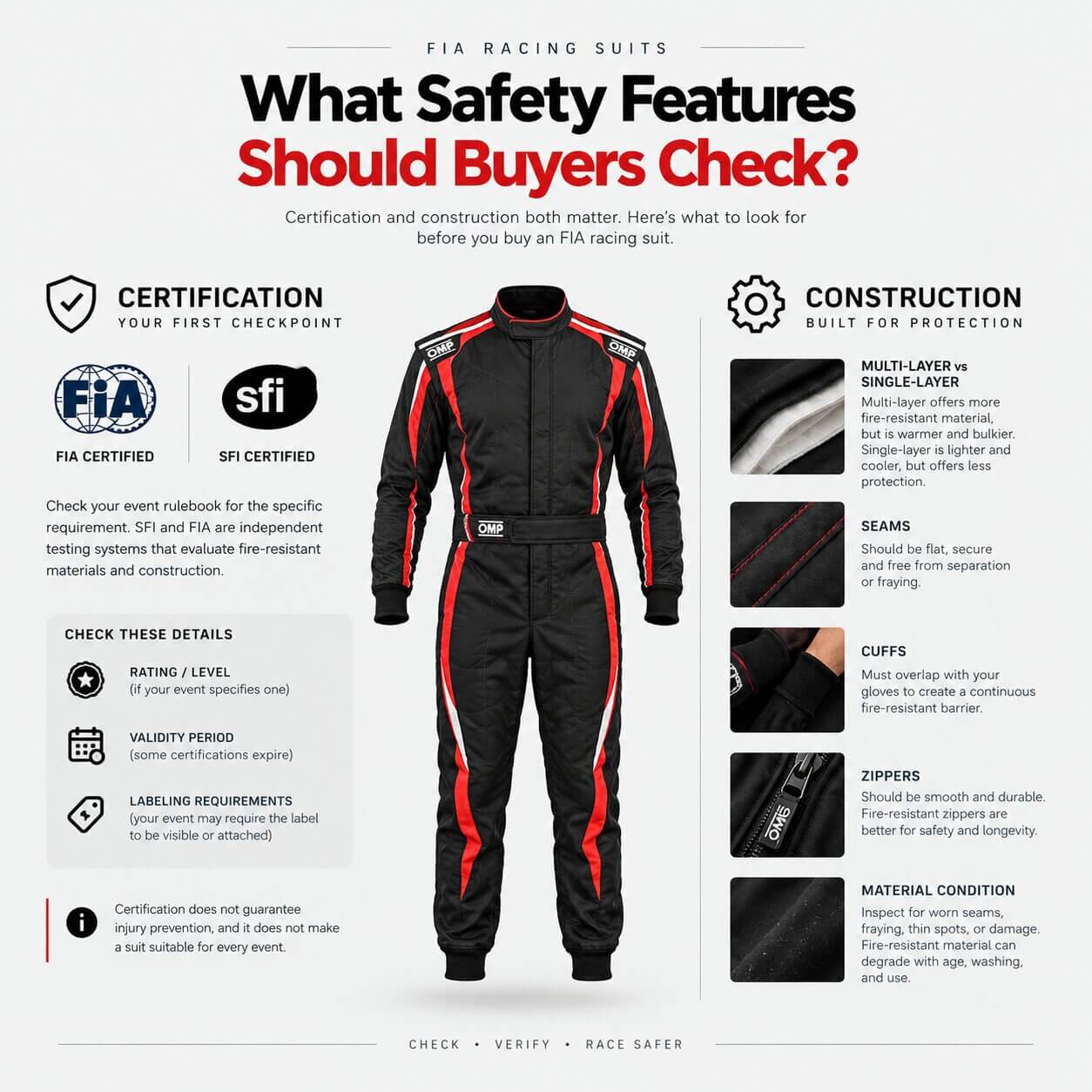
Safety features in an FIA racing suit fall into two categories: certification and construction. Both matter, but they matter in different ways.
Certification is your first checkpoint. Check your event rulebook for the specific requirement. Many club events require either SFI certification or FIA certification. SFI and FIA are independent testing systems that evaluate fire-resistant materials and construction. A suit with a valid certification label indicates it has been tested to a defined standard. However, certification does not guarantee injury prevention, and it does not make a suit suitable for every event or every driver.
Before you buy, confirm three details about the certification: the rating or level (if your event specifies one), the validity period (some certifications expire), and any labeling requirements (your event may require the label to be visible or attached). Check the product label, the manufacturer documentation, and the certification patch. Do not assume a suit is legal for your event until you have verified these details against your event rulebook.
Construction features support protection through how the suit is built. A multi-layer suit offers more fire-resistant material between you and the cockpit, which helps slow heat transfer longer than a single-layer suit. However, multi-layer suits are warmer and bulkier, which may affect comfort during long sessions or in warm weather. A single-layer suit is lighter and cooler but offers less fire-resistant coverage, so it may not meet all event requirements.
Seams, cuffs, and zippers are construction details that affect both protection and comfort. High-quality seams should be flat and secure, not prone to separation or fraying. Cuffs should overlap with your gloves to create a continuous fire-resistant barrier from your wrists to your suit sleeves. A poorly fitting cuff-to-glove connection leaves a gap that reduces the protective benefit of both the suit and the gloves. Zippers should be smooth and durable, and fire-resistant zippers are better than standard zippers for safety and longevity.
Material condition matters more than many buyers realize. A suit with worn seams, fraying edges, thin spots, or damage from previous incidents may need inspection, repair, or replacement before you use it again. Fire-resistant material can degrade with age, washing, and use. Before you buy a used suit or use an old suit you already own, inspect it carefully for any signs of wear or damage. If you have any doubt about the condition, contact the manufacturer or a qualified gear specialist.
How Fit and Sizing Affect Cockpit Comfort
Fit is where most buying mistakes happen, and it is also where many drivers make their decision based on the wrong information. You cannot judge a racing suit fit by trying it on while standing in front of a mirror. You must measure yourself and test the suit while seated in your racing cockpit, or at least in a car seat that mimics your racing position.
Start by measuring your key dimensions: sleeve length from the center back of your neck to your wrist, shoulder width across the back, torso length from shoulder to hip, and chest and waist circumference while seated. Do not measure while standing. A racing suit that fits while you are standing upright will often feel too long in the sleeves and too tight in the shoulders once you are seated and leaned back in a racing cockpit.
When you try on a suit in your cockpit, check these specific points: Can you grip the steering wheel without the sleeves riding up? Can you move your shoulders and arms freely for steering inputs without the suit bunching? Does the torso stay in place when you lean back in the seat, or does it ride up? Do the cuffs overlap properly with your racing gloves? Can you reach the pedals and shifter without the suit restricting your legs?
A suit that is too loose will bunch under your harness, create hot spots where the material folds, and leave gaps between the suit and your gloves or shoes. A suit that is too tight will fatigue your shoulders, restrict your steering, and make long sessions uncomfortable. Both problems reduce your focus on driving and may even affect your safety if you are distracted by discomfort or restricted movement.
Common buying mistakes in sizing include: buying a suit that fits your street clothes instead of your racing position, ignoring sleeve length because "you can roll them up," choosing a size based on your usual shirt size without checking racing suit size charts, and assuming custom sizing is always necessary when a standard size would work fine. Many drivers fit standard sizes well. Custom sizing adds real value only when your proportions fall outside typical size charts or when you have tested a standard size in your cockpit and found it does not work.
Which Materials and Construction Details Matter?
FIA racing suits use fire-resistant materials such as Nomex or other aramid-based fabrics. These materials are designed to resist ignition and slow heat transfer. They are not fireproof, and they do not prevent burns, but they do help reduce burn risk by providing a protective layer.
Single-layer suits use one layer of fire-resistant material. They are lighter, cooler, and more affordable. They are suitable for many club racing events and drivers who prioritize comfort and mobility. Single-layer suits still provide meaningful fire-resistant protection, but they offer less total material between you and a heat source than multi-layer suits.
Multi-layer suits use two or more layers of fire-resistant material, sometimes with different fabric weights or textures. They offer broader fire-resistant coverage and longer heat-transfer resistance, which can be valuable in high-risk environments or for drivers who want additional protection. However, multi-layer suits are warmer, bulkier, and less mobile. They may feel restrictive in a tight cockpit or during extended sessions in warm weather. They also cost more.
Fabric weight and weave affect both protection and comfort. Heavier fabrics offer more durability and longer heat-transfer resistance but feel stiffer and warmer. Lighter fabrics feel more flexible and cool but may wear faster and offer less total protection. There is a trade-off, and the right choice depends on your racing discipline, cockpit space, event requirements, and personal comfort preferences.
When comparing suits at different price points, consider what you are paying for. A higher-priced suit may offer better construction quality, more durable seams, smoother zippers, better cuff design, or multi-layer material. A lower-priced suit may still meet your event requirements and fit your cockpit well, but it may have simpler construction, less durable materials, or fewer premium features. Neither is wrong for every driver; it depends on your priorities, your budget, and how long you plan to use the suit.
Standard Size vs Custom Size: Which Should You Choose?
Standard sizing works well for most drivers. Manufacturers design size charts based on typical proportions, and many drivers fit these charts without issues. Standard suits are faster to receive, less expensive, and easier to return or exchange if the fit does not work.
Custom sizing adds value when your proportions fall outside typical size charts. If you are very tall, very short, have long arms or a long torso, or have proportions that do not match standard sizing, a custom suit can solve fit problems that no standard size can fix. Custom sizing also helps when you have tested a standard size in your cockpit and found specific fit issues, such as sleeves that are too long, a torso that rides up, or shoulders that are too tight.
The custom sizing process typically involves providing detailed measurements, often while seated in your racing position, and sometimes includes communication with the manufacturer about your specific cockpit layout and comfort priorities. Custom suits take longer to receive (often several weeks) and cost more than standard sizes. However, if you know your proportions are non-standard or if you have already identified specific fit problems, custom sizing is worth the extra time and cost.
Before you commit to custom sizing, try a standard size in your cockpit first if possible. Many drivers discover that a standard size works better than they expected once they actually sit in the car. If you are buying online and cannot try the suit in your cockpit before purchasing, measure yourself carefully, compare your measurements to the size chart, and contact the manufacturer if you are between sizes or unsure about fit. A good manufacturer will help you choose the right standard size before you buy, which saves you money and time.
Final Buying Advice from MotoSpeeds
Your buying decision comes down to three sequential steps: certification and event compliance, fit and cockpit comfort, and materials and construction that match your priorities.
Step one is non-negotiable. Check your event rulebook for the specific certification requirement, validity period, and any labeling details. Confirm that any suit you are considering carries the correct certification and meets all event rules. This step prevents the most expensive mistake: buying a suit that does not meet your event requirements.
Step two is where you eliminate discomfort and safety gaps. Measure yourself seated in your racing cockpit. Test the suit in that position if possible, or ask the manufacturer for guidance on fit for your specific car and proportions. Confirm that the suit allows full arm and shoulder mobility, that cuffs overlap properly with your racing gloves, and that the torso stays in place when you are leaned back in the seat. A suit that fits your cockpit is a suit you will wear consistently and confidently.
Step three is where you balance materials, construction, and budget. Decide whether single-layer or multi-layer construction matches your racing discipline, cockpit space, and comfort priorities. Check seams, cuffs, and zippers for quality. Consider the durability and condition of the material. Then compare options within your budget and choose the suit that best matches your priorities.
Drivers who want to compare suits, gloves, shoes, and related motorsport apparel can explore our
for car racing gear built around fit, comfort, and safety awareness.After you buy your FIA racing suit, inspect it regularly for signs of wear, damage, or material degradation. Check seams for fraying, cuffs for wear, and the overall material for thin spots or damage. If you are in an incident or if the suit shows damage, inspect it carefully or contact the manufacturer before you use it again. Fire-resistant material can degrade with age and use, and a damaged suit may need repair or replacement to maintain its protective function.
For drivers comparing real gear details before ordering, the
shows how material, fit, and protective features work together in a real racing suit.You are now ready to make a clear buying decision. You understand what your event requires, what your cockpit demands, and what materials and construction features support both comfort and protection. The right FIA racing suit for club racing is the one that meets your event rules, fits your body and cockpit properly, and matches your racing discipline and budget. Take your time, measure carefully, and do not rush the decision. A well-chosen suit becomes one less thing to worry about on race day.
FAQ: Common Questions About Buying an FIA Racing Suit for Club Racing
What is the difference between SFI and FIA certification?
SFI and FIA are independent testing systems that evaluate fire-resistant materials and construction. Both indicate that a suit has been tested to a defined standard, but they use different test methods and rating systems. Your event rulebook specifies which certification is required. Neither certification guarantees injury prevention; both indicate that the suit has been tested to a specific standard. Check your event rules and the product label before buying to confirm the suit carries the correct certification for your event.
Can I use a motorcycle racing suit for car racing?
Motorcycle and car racing suits are designed for different cockpit positions and movement patterns. A motorcycle suit is built for the forward-leaning, arm-extended position of a motorcycle rider. A car racing suit is built for the seated, reclined position of a car driver. A motorcycle suit worn in a car cockpit will often have sleeves that are too long, a torso that rides up, and poor cuff overlap with your racing gloves. Use a car racing suit designed for your specific discipline and cockpit layout, not a motorcycle suit.
How often should I replace my FIA racing suit?
Replace your FIA racing suit if it shows significant wear, damage, or material degradation, or if its certification expires. Fire-resistant material can degrade with age, washing, and use. If seams fray, cuffs wear thin, or the material develops holes or weak spots, the suit may need replacement. Check your certification label for the validity period; some certifications expire after a set number of years. Inspect your suit regularly and contact the manufacturer if you are unsure about its condition or safety.
Should I buy a multi-layer or single-layer FIA racing suit?
Single-layer suits are lighter, cooler, and more affordable, and they work well for most club racing drivers and events. Multi-layer suits offer more fire-resistant material and longer heat-transfer resistance, but they are warmer and bulkier. Choose based on your racing discipline, cockpit space, event requirements, and comfort priorities. A drag racer in a wide cockpit might prefer multi-layer protection. A karting driver in a tight seat might prefer single-layer mobility. Check your event rulebook first to confirm any minimum requirements.
Can I wear a racing suit without a balaclava, racing gloves, and racing underwear?
A racing suit works best as part of a complete fire-resistant system that includes a balaclava (head and neck coverage), racing gloves (wrist and hand coverage), and racing underwear (torso and leg coverage under the suit). These layers work together to create continuous fire-resistant protection. A suit alone leaves your neck, head, wrists, hands, and legs partially exposed. Check your event rulebook for the specific layers and coverage required, and build your gear set accordingly. MotoSpeeds offers matching suits, gloves, shoes, balaclavas, and underlayers designed to work together.
What if I am between sizes in an FIA racing suit?
If you are between sizes, measure yourself seated in your racing cockpit and compare your measurements to the size chart. Contact the manufacturer or a gear specialist for guidance on which size will work better for your specific proportions and cockpit layout. Generally, if you are between sizes, choose the smaller size if you prioritize a snug fit and maximum mobility, or the larger size if you prioritize comfort and layering space. Do not assume you need custom sizing until you have tested a standard size in your cockpit or received expert guidance.
Is a fire-resistant racing suit fireproof?
No. A fire-resistant racing suit is designed to resist ignition and slow heat transfer, but it is not fireproof and does not prevent burns. Fire-resistant material helps reduce burn risk by providing a protective layer between your skin and a heat source, but protection depends on the correct rating, proper fit, condition, layering, and the specific racing environment. No gear removes all racing risk. Wear your suit as part of a complete fire-resistant system that includes a balaclava, racing gloves, and racing underwear, and inspect it regularly for damage or wear.