
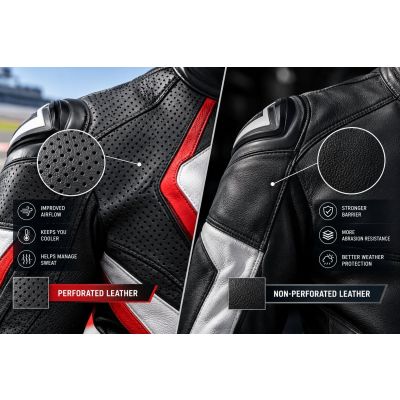
Perforated vs Non-Perforated Motorcycle Racing Suits: A Buyer's Guide
You're standing in front of two racing suits that look similar at first glance. One has small holes punched through the leather. The other is solid leather throughout. The salesperson says one is better for summer, but you're not sure what that actually means for your safety, comfort, or budget. This confusion is exactly why choosing between a perforated vs non-perforated motorcycle racing suit matters — and why the decision goes deeper than just ventilation.
The choice affects how much air flows through your gear, how much protection the leather provides, how long the suit lasts, and whether you can wear it year-round or only in specific conditions. A rider buying their first racing suit, a track-day competitor preparing for summer events, or someone with a non-standard body shape all face different priorities when making this decision. Understanding the real trade-offs between these two designs helps you buy gear that keeps you safer without sacrificing comfort or durability.
Quick Buying Advice:
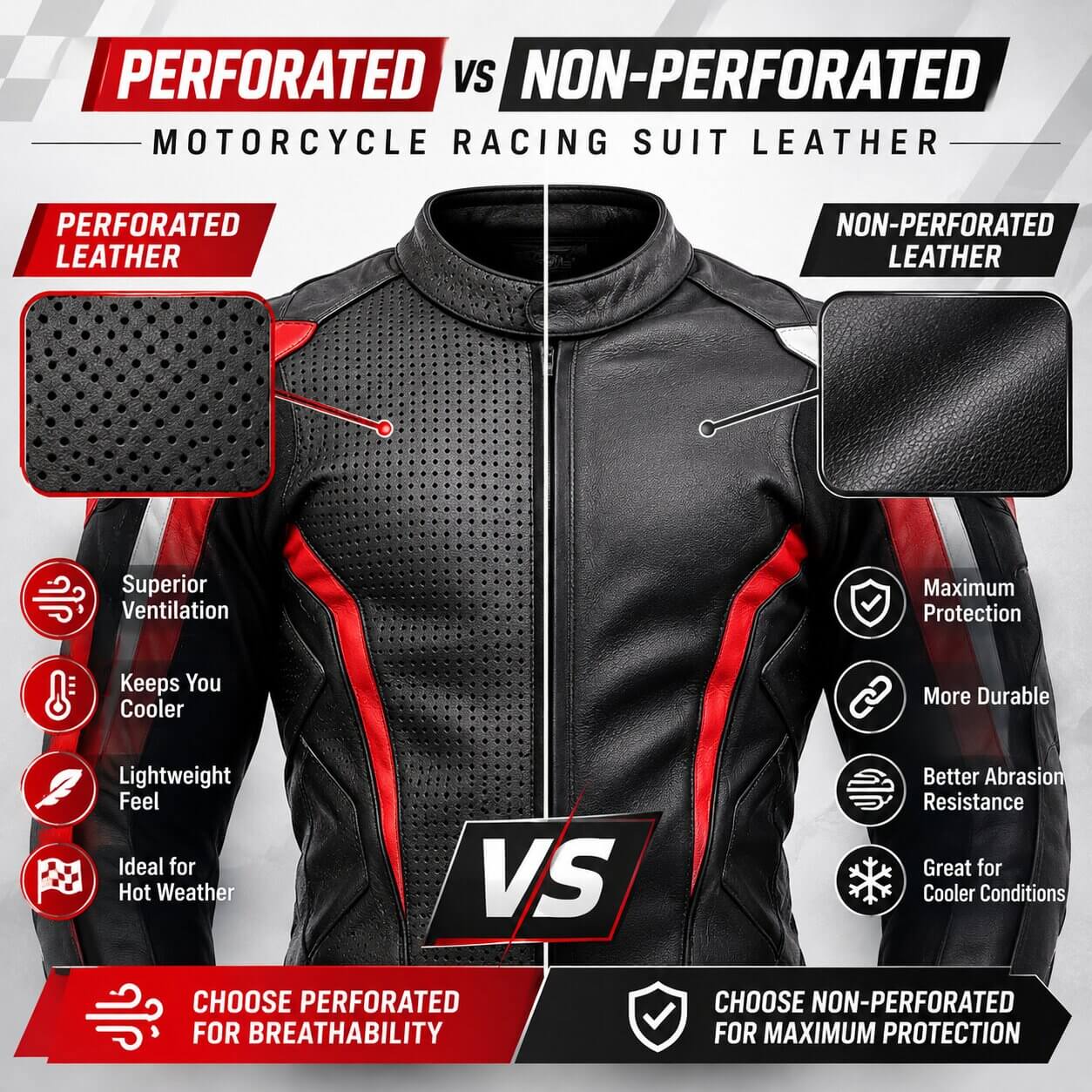
Perforated suits offer better ventilation and comfort in hot weather or during intense track sessions where airflow matters. Non-perforated suits provide superior abrasion resistance and durability across all temperatures and riding conditions. If you ride primarily in hot weather or on track days during summer, perforated leather is worth the investment. If you need gear for year-round riding or prefer maximum protection, non-perforated leather is the safer choice. Many riders benefit from owning both — a perforated suit for summer and a non-perforated suit for other seasons.
- What Should Riders Know Before Buying a Racing Suit?
- How to Choose Gear Based on Your Riding Style
- What Safety Features Should Buyers Check?
- How Fit and Sizing Affect Comfort and Protection
- Which Materials and Construction Details Matter?
- Standard Size vs Custom Size: Which Should You Choose?
- Final Buying Advice from MotoSpeeds
What Should Riders Know Before Buying a Racing Suit?
A racing suit is not just a fashion choice or a comfort upgrade — it is a safety system designed to protect your skin, joints, and internal organs during a crash. The perforated vs non-perforated distinction is really a question about how you want to balance protection, ventilation, and durability for your specific riding conditions.
Perforated leather has small holes (typically 2–4 mm in diameter) punched throughout the material. This design removes material from the leather itself, which reduces weight and increases airflow. The holes are strategically placed in high-heat areas like the back, chest, and sides — locations where ventilation matters most but where protection is still critical. Non-perforated leather is solid throughout, with no holes. Every millimeter of leather remains intact, which means maximum abrasion resistance and longer lifespan.
The key insight is that perforations reduce the total surface area of leather that protects your skin in a slide. A study of abrasion-resistant materials shows that removing even 15–20% of material through perforations noticeably decreases the distance you can slide before leather wears through. This trade-off is intentional and acceptable for hot-weather riders, but it matters if you ride in conditions where crashes are more likely or where maximum protection is the priority.
Before you decide which type suits your needs, ask yourself three questions: Where do I ride most often — track, street, or both? What is the typical temperature and humidity when I ride? How much do I prioritize maximum protection versus comfort in hot conditions? Your honest answers to these questions will guide the rest of your buying decision.
How to Choose Gear Based on Your Riding Style
Your riding style and environment are the foundation of choosing between perforated and non-perforated. Different riders face different risks and have different comfort needs.
Track-day riders in hot weather benefit most from perforated suits. Track days typically run in summer or during warm seasons. You spend two to four hours in your gear, often in direct sun, with high physical exertion. A perforated suit keeps your core temperature lower, reduces fatigue, and lets sweat evaporate instead of pooling inside the suit. Since track days happen on closed courses with predictable surfaces and controlled speeds, the slightly reduced abrasion resistance of perforated leather is an acceptable trade-off. Many track riders own a perforated suit specifically for summer events and a non-perforated suit for spring and fall sessions when temperatures drop.
Street riders who ride year-round or in mixed conditions should prioritize non-perforated suits. Street riding exposes you to unpredictable hazards — gravel, potholes, debris, other vehicles. A crash can happen at any time and at any temperature. Non-perforated leather gives you the maximum protection margin. If you ride primarily in warm weather but occasionally venture out in cooler seasons, a non-perforated suit is the safer all-purpose choice. You sacrifice some ventilation, but you gain confidence that your gear is protecting you equally well in all conditions.
Sportbike riders who split time between track and street face a genuine dilemma. If you ride track days three or four times per year and street ride the other 360 days, a non-perforated suit makes sense because street riding is your primary exposure. If you attend track days monthly, a perforated suit for track and a non-perforated suit for street is a worthwhile investment. Some riders compromise by choosing a non-perforated suit with good ventilation design — mesh panels, underarm zippers, or strategic fabric placement — that offers more airflow than a fully sealed suit without sacrificing abrasion resistance.
Beginner riders should start with non-perforated suits. As a new rider, your crash risk is statistically higher. Your body positioning may not be perfect, which means different parts of your gear might make contact during a slide. Non-perforated leather gives you the maximum protection margin while you build skills and learn how your gear performs. Once you have logged hundreds of hours and understand your riding patterns and typical conditions, you can make a more informed decision about adding a perforated suit for specific use cases.
What Safety Features Should Buyers Check?
Protection quality depends on multiple factors beyond perforation. Armor placement, leather thickness, CE certification levels, and stitching all matter as much as whether the leather is perforated.
CE-certified armor (EN 1621-1 for limbs, EN 1621-2 for back protectors) is the baseline standard. Look for Level 2 armor in the knees, hips, and elbows if you ride track or aggressive street. Level 2 absorbs more impact energy than Level 1 under the same test conditions. For racing suits, check that armor is securely attached and positioned correctly — it should not shift during movement or impact. Loose armor or poorly secured pockets can migrate during a crash, leaving you unprotected exactly when you need it most.
Leather thickness is measured in millimeters. Cowhide typically ranges from 1.0–1.3 mm for racing suits. Thicker is not always better — 1.3 mm cowhide offers excellent protection but can feel stiff and heavy. Kangaroo leather is stronger per millimeter than cowhide, so 1.0–1.1 mm kangaroo provides comparable protection to 1.2 mm cowhide while being lighter and more flexible. The perforations do not significantly affect leather thickness, so a 1.2 mm perforated suit still has 1.2 mm of leather where it remains solid — the perforations just remove small sections strategically.
Stitching quality determines how well the suit holds together during a crash. Look for reinforced seams, especially at the shoulders, underarms, and inseams where stress concentrates. Double-stitched or triple-stitched seams are stronger than single stitches. A racing suit should have at least 4–5 stitches per inch in critical areas. Poor stitching fails under the stress of a slide, and once a seam fails, the suit loses its integrity and protection value.
The lining material affects comfort and durability. A mesh or breathable lining allows moisture to escape and dries faster. A cotton or cotton-blend lining is comfortable but absorbs sweat and takes longer to dry. For hot-weather or perforated suits, a breathable lining works better. For non-perforated suits used in cooler weather, lining choice is less critical.
Zipper quality matters more than many riders realize. A racing suit needs a strong zipper that locks securely and does not separate during impact. Look for YKK or similar high-quality zippers rated for heavy use. Cheap zippers fail at the worst moment — during a crash when you need the suit to stay closed and intact.
How Fit and Sizing Affect Comfort and Protection
Fit is where many riders make costly mistakes. A suit that looks good hanging on a rack but does not fit your body correctly compromises both comfort and safety.
A properly fitted racing suit feels snug but not restrictive. When you sit on the bike in your riding position, your arms should bend comfortably at the elbows without pulling at the shoulders or chest. Your legs should allow a full range of motion for gripping the tank and working the pegs. If your arms feel restricted when gripping handlebars in a racing position, the suit is too tight in the shoulders or chest — and that tightness will fatigue you over a two-hour track session. If the suit feels loose around your torso or limbs, it will shift during a crash, which means armor can migrate away from where it needs to be.
Length matters as much as width. A suit that is too short in the arms or legs leaves gaps between the suit and your gloves or boots. A suit that is too long bunches up, creates folds that can catch on the bike, and shifts more easily during a crash. Stand in your riding position — not standing straight — and have someone check that the suit fits smoothly without excess fabric or gaps.
Perforated suits fit the same way as non-perforated suits. The perforations do not affect sizing or fit. However, some riders find that a perforated suit feels slightly less restrictive because the perforations allow a tiny bit more stretch and flex in the leather. This is a minor effect and should not influence your sizing decision.
Common buying mistakes: Many riders buy a suit one size too large because they are worried about fit or want room to layer underneath. A larger suit offers no advantage — it shifts more in a crash, armor does not sit correctly, and you feel disconnected from the bike. Buy your true size. If you wear a base layer underneath (which is not necessary in hot weather), it should be thin and form-fitting. Another mistake is buying a suit based on your street clothing size. Racing suit sizing is different. A rider who wears a 40-inch chest in a street jacket might wear a 38 or 36 in a racing suit because racing suits are cut tighter and more form-fitting. Always try on or check the brand's specific size chart before ordering.
Which Materials and Construction Details Matter?
The quality of leather and construction methods determines how long your suit lasts and how well it protects you across multiple crashes or slides.
Cowhide is the most common racing suit material. It is durable, widely available, and affordable. A 1.2 mm cowhide suit offers excellent protection and typically costs $800–$1,500. Cowhide is slightly heavier than kangaroo leather and feels stiffer when new, but it breaks in well and lasts longer under repeated use. If you plan to wear your suit frequently or use it for multiple seasons, cowhide is a solid choice.
Kangaroo leather is lighter, stronger per millimeter, and more flexible than cowhide. A 1.0 mm kangaroo suit can match the protection of a 1.2 mm cowhide suit but feel more comfortable and lighter in hot weather. Kangaroo suits typically cost $1,200–$2,000 because the material is more expensive and requires more skilled craftsmanship. For track riders who value comfort and responsiveness, kangaroo is worth the premium. For street riders or beginners, cowhide offers better value.
Perforated leather is available in both cowhide and kangaroo. The perforation process does not change the base material properties — it just removes small sections. A perforated kangaroo suit is still lighter and more flexible than a non-perforated cowhide suit. The choice between materials is separate from the choice between perforated and non-perforated.
When is it worth paying more: Investing in premium construction matters when you ride frequently or in high-risk conditions. A suit with reinforced seams, high-quality armor, and premium leather lasts longer and protects better. If you ride track days monthly or commute on a sportbike regularly, a $1,500+ suit is worth the cost because it will protect you better and last 5–10 years. If you ride occasionally or mostly on weekends, a mid-range suit at $800–$1,200 is sufficient. Do not pay for features you will not use — a track-specific suit with aggressive armor placement is wasted money if you ride street only.
Standard Size vs Custom Size: Which Should You Choose?
Most riders fit standard sizes well. Custom sizing adds real value only when your body proportions fall outside the typical range.
Standard sizes work for riders with typical arm length-to-torso ratios, average shoulder width, and regular inseams. If you are 5'10" and weigh 180 pounds, a standard Large or Medium will likely fit you well. Brands like MotoSpeeds design standard sizes to fit a wide range of body types, and size charts are increasingly accurate.
Custom sizing makes sense if you have disproportionately long or short arms, narrow or very broad shoulders, or an unusual inseam. A rider who is 6'3" with proportionally short arms, or 5'4" with long arms, will struggle to find a standard size that fits both dimensions correctly. Custom sizing lets you adjust arm length, torso length, and width independently. The trade-off is cost — custom suits typically run $500–$1,000 more than standard sizes — and lead time, which can be 6–12 weeks instead of 1–2 weeks for off-the-shelf gear.
Before ordering custom, measure yourself carefully using the brand's sizing guide and compare your measurements to their standard size chart. Many riders discover they fit a standard size better than they expected. If you are between sizes or just outside the range in one dimension, consider ordering the standard size that fits your torso and shoulders, then having a tailor adjust sleeve length or inseam. This costs $100–$300 and is much faster than custom ordering.
Tip of the Day: Trunk Treat on Two Wheels transform Your Ride to a Little Halloween Magic!
This Halloween, remember that the right racing suit is your best treat on two wheels! Perforated suits offer extra airflow to keep you cool during intense rides, while non-perforated suits provide greater coverage and protection against the elements. Whether you're chasing thrills on the track or enjoying a spooky nighttime ride, choose the suit that matches your riding conditions. Stay safe, stay comfortable, and let your gear do the trick—not the treat!
Final Buying Advice from MotoSpeeds
Choosing between a perforated vs non-perforated motorcycle racing suit comes down to three decisions: your primary riding conditions, your acceptable level of compromise between protection and comfort, and your budget for potentially owning multiple suits.
If you ride primarily in hot weather or spend significant time on track in summer, a perforated suit is the right choice. The ventilation benefit is real and meaningful, and the slight reduction in abrasion resistance is acceptable for controlled environments. If you ride year-round, in mixed temperatures, or prioritize maximum protection, a non-perforated suit is the safer choice. If you ride track days and street, owning both is ideal — a perforated suit for summer track days and a non-perforated suit for street and cooler weather.
After you decide on perforated vs non-perforated, focus on fit, armor placement, and leather quality. A well-fitted suit with proper CE-certified armor and quality construction protects you far better than a poorly fitted suit made from premium materials. Buy your true size. Check that armor sits correctly and stays in place during movement. Verify that seams are reinforced and zippers are high-quality. These details matter more than brand prestige or aesthetic features.
Riders who want to explore options for both track and street riding can examine our
to see how different suit styles balance protection and ventilation for various conditions.Take your time with this decision. Try on suits if possible. Check return policies so you can test fit at home. Ask other riders about their experience with specific brands and models. Read reviews that focus on fit and protection, not just aesthetics. A racing suit is one of the most important safety investments you will make as a rider.
For riders comparing real protective gear and armor placement, the
demonstrates how reinforced construction, proper armor positioning, and fit work together to deliver protection when it matters most.Do perforated motorcycle suits offer less protection than non-perforated suits?
Perforated suits do offer slightly less abrasion resistance because material is removed through the perforations. Studies show that removing 15–20% of leather surface area through perforations noticeably decreases the distance you can slide before leather wears through. However, this reduction is intentional and acceptable for hot-weather or track-day riding where ventilation matters. The reduction is not dramatic — a perforated 1.2 mm cowhide suit still protects significantly better than unprotected skin or textile gear. For street riding or maximum protection in all conditions, non-perforated is the safer choice.
Can I wear a perforated racing suit in cool weather?
Yes, you can wear a perforated suit in cool weather, but it will not be as comfortable as a non-perforated suit. The perforations allow airflow even when you do not need it, which means you will feel cold air and lose body heat faster. Many riders own a perforated suit specifically for summer and a non-perforated suit for other seasons. If you ride primarily in warm weather, a perforated suit is ideal. If you ride in mixed temperatures, a non-perforated suit is more versatile year-round.
What is the difference between CE Level 1 and Level 2 armor in a racing suit?
CE Level 2 armor absorbs more impact energy than Level 1 under the same EN 1621 test conditions. Both meet safety standards, but Level 2 provides better protection for higher-impact scenarios like track riding or aggressive street riding. Level 2 is slightly thicker and heavier, which is why some casual riders choose Level 1 to reduce bulk. For track days or racing, Level 2 is worth the investment. For casual street riding, Level 1 is acceptable. Check the armor rating in your knees, hips, elbows, and back before buying.
How do I know if a racing suit fits correctly?
A properly fitted racing suit feels snug but not restrictive when you are in your riding position on the bike. Your arms should bend comfortably at the elbows without pulling at the shoulders. Your legs should allow full range of motion for gripping the tank and working the pegs. There should be no gaps between the suit and your gloves or boots, and no excess fabric that bunches up. Stand in your riding position — not standing straight — and have someone check the fit. If you feel restricted or the suit shifts when you move, it does not fit correctly. Buy your true size, not a size larger because you are worried about fit.
Is kangaroo leather better than cowhide for motorcycle suits?
Kangaroo leather is lighter and stronger per millimeter than cowhide, so a 1.0 mm kangaroo suit can match the protection of a 1.2 mm cowhide suit while being more flexible and comfortable. Kangaroo is the better choice for riders who prioritize comfort and responsiveness, especially in hot weather or on track. Cowhide is more durable under repeated use, more widely available, and more affordable. For track riders who ride frequently, kangaroo is worth the premium. For street riders or beginners, cowhide offers better value. The choice depends on your budget and riding frequency, not on absolute protection quality.
Should I buy a custom-sized racing suit or a standard size?
Buy a standard size first. Most riders fit standard sizes well, and sizing charts are increasingly accurate. Custom sizing adds $500–$1,000 to the cost and requires 6–12 weeks lead time. Order custom only if you have disproportionate arm length, narrow or very broad shoulders, or an unusual inseam that falls outside the standard size range. Before ordering custom, measure yourself carefully using the brand's sizing guide and compare to their standard chart. Many riders discover they fit a standard size better than expected. If you are between sizes, consider ordering the size that fits your torso and shoulders, then having a tailor adjust sleeve or inseam length for $100–$300.
How long does a motorcycle racing suit last?
A well-made racing suit from quality leather with reinforced seams can last 5–10 years with regular use if you maintain it properly. Lifespan depends on how often you ride, whether you have crashes or slides, and how you care for the suit. Clean and condition the leather regularly, store it away from direct sunlight, and avoid extreme heat or humidity. A suit used for track days 10 times per year will last longer than a suit used for weekly street commuting. If you have a significant crash or slide that damages the leather or seams, the suit's protective value is compromised and should be replaced. Budget for replacing your racing suit every 5–7 years if you ride frequently.