
How to Choose Motorcycle Touring Gloves for Long-Distance Riding
If you're planning a motorcycle tour lasting more than a few hours, your gloves might be the first piece of gear to fail you. Most riders don't realize that gloves designed for commuting or casual riding create problems on long highway stretches: fingers go numb from wind chill, palms develop pressure points that become unbearable after hour three, armor shifts out of position, or materials that feel comfortable at 40 mph become restrictive at 65 mph for six consecutive hours.
Choosing the right motorcycle touring gloves means understanding what separates casual riding gloves from true long-distance touring gear. A touring glove must protect your hands during a crash, keep them comfortable and functional over many hours in the saddle, manage weather conditions specific to your route, and maintain proper armor positioning throughout your ride. The difference between a $60 glove and a $150 glove often isn't flashier materials—it's construction details that only matter when you've been riding for five hours straight.
This guide walks you through the actual buying decisions touring riders face: What protection do you genuinely need? How should touring gloves fit differently than street gloves? Which materials handle both long-distance comfort and crash protection? And how do you avoid the common mistakes that leave riders uncomfortable, unprotected, or forced to replace gear mid-trip?
Quick Buying Advice:
For long-distance touring, prioritize gloves with reinforced palms, pre-curved fingers, adjustable wrist closure, and armor that stays in place during extended grip. Choose materials based on your typical weather: textile with thermal lining for mixed conditions, leather for maximum durability and abrasion resistance, or highly ventilated mesh for hot-weather touring. Fit matters more than brand—gloves should feel snug but not restrictive when gripping the handlebars in your actual riding position, with no wrinkles across the palm that could create pressure points during long hours.

- What Should Riders Know Before Buying Motorcycle Touring Gloves?
- How to Choose Touring Gloves Based on Your Riding Style
- What Safety and Touring Features Should Buyers Check?
- How Fit and Sizing Affect Long-Distance Comfort and Protection
- Which Materials and Construction Details Matter?
- Standard Size vs Adjustable Fit: Which Should You Choose?
- Final Buying Advice from MotoSpeeds
What Should Riders Know Before Buying Motorcycle Touring Gloves?
Touring gloves exist in a different category than casual riding gloves because long-distance riding creates demands that short commutes don't. When you're on the road for four, six, or eight hours, your hands experience sustained wind pressure, continuous grip fatigue, temperature swings across different elevations or regions, and extended contact with materials that feel fine for thirty minutes but become uncomfortable for hours.
A touring glove must accomplish three things simultaneously: protect your hands during a crash, keep your hands functional and comfortable during extended riding, and adapt to changing weather without requiring you to stop and change gear. This is harder than it sounds. A pair of gloves that offers maximum abrasion resistance through thick leather might feel stiff and restrictive on a six-hour ride. A glove optimized for ventilation on hot days might leave your fingers cold if weather shifts unexpectedly.
The most important distinction is between protection and comfort. You need both, but they sometimes conflict. A touring glove prioritizes protection first—your hands will touch the pavement if you crash, and proper armor placement and material durability directly affect injury risk. But if the glove becomes so uncomfortable during long hours that you remove it or grip too loosely to maintain control, the protection becomes irrelevant. The right touring glove finds a practical balance between these two needs.
How to Choose Touring Gloves Based on Your Riding Style
Your typical riding distance, speeds, road conditions, and climate determine which glove features matter most. A weekend warrior riding smooth highways in mild weather has different priorities than someone doing multi-day adventure touring through changing seasons or a commuter who occasionally takes longer trips.
If you ride primarily on highways at steady speeds for four to eight hours at a time, your priority is palm comfort, wrist support, and consistent armor positioning. Highway touring means repetitive hand position and sustained grip pressure. You need gloves with reinforced palms designed to distribute pressure across a wider area, not concentrated in one spot. Look for pre-curved fingers that match your natural grip position when holding handlebars. Your wrist closure system matters because loose wrists allow gloves to shift during long hours, creating pressure points and allowing wind to penetrate.
If you're doing adventure or mixed-terrain touring where road surfaces vary, weather might change unexpectedly, and you'll encounter gravel, dirt, or off-road sections, your priorities shift toward versatility and durability. You need gloves that handle abrasion across multiple surfaces, not just asphalt. Consider gloves with reinforced knuckle and finger protection, because adventure riding involves more varied hand positions and potential for different impact angles. Weather protection becomes more critical because you might encounter rain, cold, or temperature swings you didn't expect when you left.
If you're a beginner buying your first touring gloves, start with gloves that balance protection with comfort rather than optimizing for one extreme. Experienced riders often buy specialized gloves for specific conditions—separate gloves for hot weather, cold weather, and rain. Beginners benefit from gloves that work reasonably well across a wider range of conditions. Look for textile gloves with removable thermal liners, which give you flexibility to adapt to changing weather without buying multiple pairs.
For hot-weather touring where temperatures regularly exceed 80°F, ventilation becomes the primary concern—but not at the expense of protection. Mesh gloves with reinforced palms and knuckles work well for hot climates. The mesh allows airflow, but the reinforced areas still provide abrasion resistance where you need it most. Some riders use mesh gloves for hot-weather touring and carry a second pair of gloves for unexpected cooler conditions or rain.
What Safety and Touring Features Should Buyers Check?
Protective equipment in gloves serves one purpose: reducing injury risk if your hands contact the pavement during a crash. This means armor placement, material durability, and secure attachment all matter. A glove with armor that shifts out of position during impact offers less protection than a glove with armor that stays in place.
Look for CE-certified armor (also called protectors) in the knuckles and palm. CE certification means the armor was tested and met specific impact absorption standards under controlled conditions. Level 1 protectors (the basic standard) provide moderate impact protection. Level 2 protectors provide higher impact absorption and are better for touring, especially if you ride at highway speeds. However, CE certification does not mean the armor prevents injury in all crashes. It means the armor met specific test standards. Real-world crashes vary in angle, speed, and impact surface, so armor performance varies too.
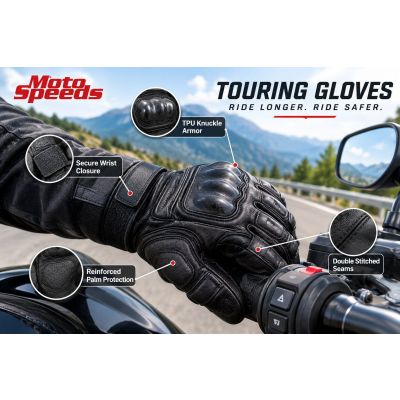
Armor must stay in place during impact, not just while you're riding. This is why glove fit and secure armor attachment matter for safety. Knuckle armor should be sewn or bonded firmly to the glove, not loose or rattling inside a pocket. Palm armor should cover the heel of your hand and the ball of your palm—the areas most likely to contact pavement if you fall forward. Some touring gloves include additional reinforcement along the side of the hand and pinky finger, which experience different impact angles depending on how your hand lands.
For touring specifically, look for reinforced seams where fingers meet the palm. This is a high-stress area during long rides when grip pressure is sustained. Reinforced seams prevent splitting and maintain armor positioning. Check that the wrist closure system is secure and adjustable. A loose wrist allows the entire glove to shift during a crash, moving armor away from critical areas. An adjustable wrist closure lets you tighten the glove enough to keep it secure without cutting off circulation during long rides.
Touchscreen compatibility matters for touring riders who use GPS navigation, check messages, or adjust music while stopped. Some touring gloves include conductive thread on the thumb and index finger, allowing you to use your phone without removing gloves. This is genuinely useful for touring because it reduces the number of times you need to remove gloves to interact with devices, which saves time and keeps your hands warmer in cool weather.
Reflective elements on the back of the hand and fingers improve visibility in low light. Touring often involves riding during dawn, dusk, or evening hours when visibility is reduced. Reflective stitching or materials don't protect you from crashes, but they make your hands more visible to other road users, which reduces crash risk overall.
How Fit and Sizing Affect Long-Distance Comfort and Protection
Fit is where most touring glove purchases go wrong. Many riders buy gloves that feel acceptable during a quick try-on in a store, then discover after two hours of riding that the glove creates pressure points, restricts finger movement, or allows the wrist to slip. Fit affects both comfort and safety because poorly fitted armor can shift during a crash and because uncomfortable gloves lead to poor hand position or reduced grip control.
The correct fit for touring gloves is snug but not restrictive. When you put the glove on and make a fist, your fingers should bend naturally without the glove pulling tight across the knuckles. If you feel tension or pulling across the back of your hand when making a fist, the glove is too small. When you grip handlebars in your actual riding position—not a vertical fist, but the angle you hold the bars while riding—your fingers should have room to flex without restriction. This is the critical test most riders skip.
The palm is where fit most affects long-distance comfort. Put on the glove and grip the handlebars in your riding position. Now look at the palm from the inside. You should see no wrinkles or bunching of material across the palm or heel. Wrinkles create pressure points that become painful after hours of sustained grip. If you see wrinkles, the glove is too large or the palm is shaped incorrectly for your hand proportions. Some riders have wider palms, others have longer palms, and glove sizing needs to match your specific hand shape, not just your glove size number.
Wrist fit determines whether the glove stays in position during long rides and crashes. The wrist closure should be snug enough that the glove doesn't rotate or shift when you're gripping the bars, but loose enough that it doesn't cut off circulation or create numbness in your fingers after an hour. If you feel tingling or numbness in your fingertips, the wrist is too tight. Adjust the closure looser and try again. If the glove rotates on your wrist when you move your hand, it's too loose.
Finger length is often overlooked but critical for touring. If your glove fingers are too short, the fingertips bunch up when you grip the bars, creating pressure and reducing sensitivity. If your glove fingers are too long, they fold over or create gaps at the fingertips, reducing your ability to feel the handlebars and control the bike. Proper finger length means your fingertips reach the end of the glove with a small amount of room—not bunched, not extended beyond the glove.
Common buying mistakes with fit include: buying gloves that feel comfortable during a quick try-on but haven't been tested in an actual riding position; choosing size based on generic sizing charts without trying the gloves on; assuming a glove will "break in" and become more comfortable (most touring gloves don't break in significantly—they either fit or they don't); and buying gloves a size larger to accommodate thermal liners, then finding them too loose without the liners. The solution is to try gloves on while simulating your actual riding grip and position, and to test them during a short ride before committing to a longer touring trip.
Which Materials and Construction Details Matter?
Glove materials determine durability, abrasion resistance, weather protection, ventilation, and feel. No single material is best for all touring conditions. Leather, textile, and mesh each have trade-offs you need to understand to make the right choice for your riding climate and distance.
Leather offers the highest abrasion resistance and durability. Leather doesn't tear easily on pavement contact and maintains its protective properties for years of use. High-quality leather also develops a natural patina and conforms to your hand over time, which some riders prefer. The downsides: leather is heavier than textile, doesn't ventilate as well (important for hot-weather touring), requires conditioning to maintain water resistance, and can become stiff in cold weather. Full-grain leather (the highest quality) is more durable than split leather or bonded leather, but it's also heavier and more expensive. For touring, full-grain or top-grain leather is worth the cost because it lasts longer and maintains its protective properties better than lower-quality leather.
Textile (synthetic fabrics like Cordura or nylon) balances protection with ventilation and weight. Textile gloves are lighter than leather, often more affordable, and typically have better ventilation. They're also easier to care for—most textile gloves can be hand-washed. The trade-off is that textile doesn't have the same abrasion resistance as leather. In a crash at highway speeds, textile will tear more easily than leather. However, modern high-quality textiles with reinforced palms and knuckles provide adequate protection for most touring riders. Textile is particularly good for touring because it adapts better to temperature changes—textile with a removable thermal liner gives you flexibility to adjust to changing weather.
Mesh (perforated material) prioritizes ventilation for hot-weather riding. Mesh gloves keep hands cooler because air flows through the material. However, mesh doesn't provide the same abrasion resistance as leather or textile. Mesh works best for hot-weather touring on smooth road surfaces where crash risk is lower. For adventure touring or riding in areas with rough road conditions, mesh is less ideal because the material won't protect your hands as well if you slide on pavement.
Reinforced palms are essential for any touring glove. The palm experiences the most abrasion during a crash and the most pressure during extended grip. Look for gloves with double or triple-layer palms, or palms made from higher-quality leather or textile than the back of the hand. Some touring gloves use leather palms with textile backs, which combines the abrasion resistance of leather where it matters most with the ventilation and weight benefits of textile elsewhere.
Thermal liners add warmth without bulk. Many touring gloves designed for mixed-season riding include removable thermal liners that you can add for cold weather or remove for warmer conditions. This flexibility is valuable for touring because weather changes as you travel or seasons shift. A glove with a removable liner effectively gives you two gloves in one. Check that the liner attaches securely and doesn't bunch up or create pressure points when installed.
Seam quality affects durability and comfort. High-quality touring gloves use reinforced stitching at stress points—where fingers meet the palm, along the sides of fingers, and around the wrist. Poor seams fail under the sustained pressure of long-distance riding or during crashes. When examining gloves before purchase, check that seams are even, tight, and reinforced with multiple passes of thread where needed.
Waterproofing matters if you tour in wet climates or encounter unexpected rain. Some gloves use waterproof membranes (similar to Gore-Tex) that block water while allowing some ventilation. Others use water-resistant treatments that slow water penetration but aren't fully waterproof. Fully waterproof gloves tend to reduce ventilation, which is a trade-off if you're touring in warm climates. For mixed-condition touring, water-resistant textile gloves offer a practical balance—they slow rain penetration enough for short showers, but they're more breathable than fully waterproof gloves.
When is it worth paying more for touring gloves? Premium touring gloves ($120–$200+) typically offer better materials (full-grain leather instead of split leather, high-quality textile with reinforced construction), more thoughtful design details (better palm reinforcement, improved armor positioning, adjustable features for different hand sizes), and better durability. If you tour regularly and expect your gloves to last multiple seasons, premium gloves provide better value over time. If you tour occasionally or are buying your first pair, mid-range gloves ($70–$120) offer solid protection and comfort at a more accessible price point. Budget gloves ($40–$70) can work for casual or short-distance touring, but they often have less robust construction and may need replacement sooner. The right choice depends on your riding frequency and how much you're willing to invest in gear that you'll use regularly.
Standard Size vs Adjustable Fit: Which Should You Choose?
Touring gloves come in two basic fit categories: standard sizing (S, M, L, XL) and adjustable fit (with multiple adjustment points). Standard sizing is simpler and often less expensive. Adjustable fit offers flexibility if your hand size falls between standard sizes or if you have non-standard proportions.
Standard sizing works well if your hands match the typical proportions for your size. Most glove manufacturers design sizes based on average hand dimensions. If you have average-length fingers, average palm width, and average wrist circumference for your size, standard sizing will fit well. The advantage is simplicity—you know your size and can order confidently. The disadvantage is that if your proportions don't match the average, the glove won't fit well no matter how carefully you choose the size.
Adjustable fit matters for riders with non-standard proportions. If you have long fingers but a narrow palm, or a wide palm but short fingers, adjustable gloves let you customize the fit. Look for gloves with adjustable wrist closures (which most touring gloves have) and gloves that offer adjustment options for finger length or palm width. Some premium touring gloves include adjustable finger closure or modular armor that can be repositioned. These features cost more but solve real fit problems for riders who don't match standard sizing.
If you're between sizes, adjustable fit often works better than choosing the larger size. Choosing a larger size to accommodate adjustment usually creates other fit problems—the palm becomes too large, causing wrinkles and pressure points, or the fingers become too long, reducing control. Adjustable gloves let you achieve a snug fit without oversizing.
Final Buying Advice from MotoSpeeds
Buying the right motorcycle touring gloves means making three clear decisions in order of importance. First, prioritize protection and fit. Choose gloves with proper armor placement, reinforced construction, and a fit that works in your actual riding position. Second, match materials and weather protection to your typical touring conditions. Third, consider aesthetics and brand preference only after the first two decisions are made.
Before you buy, simulate your actual riding scenario. Put on the gloves and grip handlebars in your riding position. Flex your fingers as if you're riding. Hold the position for a minute and check for pressure points, restriction, or discomfort. This single test prevents most fit-related buying mistakes. If the gloves don't feel right in your riding position during a test, they won't feel right after four hours on the road.
Build a touring glove collection that matches your typical riding conditions rather than buying one pair for everything. If you tour in varied seasons, consider textile gloves with removable thermal liners for spring and fall, lighter mesh gloves for summer, and insulated leather gloves for winter. If you primarily tour in one season, choose gloves optimized for that condition. If you do adventure touring in multiple climates, choose gloves that balance protection, ventilation, and durability across varied conditions.
Test new gloves on a short ride before committing to a long tour. Wear them for 30–60 minutes on a familiar route to identify any pressure points, fit issues, or comfort problems. Most fit problems become obvious within the first hour. If the gloves feel good during a short ride, they'll likely work well for longer distances. If you notice issues, exchange them before your tour.
Riders planning longer road trips can explore our
for gear designed around protection, fit, comfort, and long-distance riding.For riders comparing practical touring gear, the
shows how armor placement, construction, comfort, and fit work together in real touring equipment.Choosing the right motorcycle touring gloves for long-distance riding comes down to understanding what your hands need during extended time in the saddle. Prioritize protection and fit first, match materials to your climate, and test new gloves before you tour. The right gloves make long rides more comfortable and safer. The wrong gloves create pressure points, leave you unprotected, or become so uncomfortable that you remove them—defeating the purpose of protective gear.
Frequently Asked Questions
What's the difference between touring gloves and regular riding gloves?
Touring gloves are engineered for sustained comfort during long hours in the saddle, while regular riding gloves prioritize short-term protection. Touring gloves include reinforced palms to distribute pressure over extended grip, pre-curved fingers that match natural hand position, adjustable wrist closures to prevent shifting, and materials that balance protection with breathability. Regular gloves often have less palm reinforcement and fewer comfort features because they're designed for shorter rides where pressure points don't develop. For any ride lasting more than three hours, touring-specific gloves make a significant difference in hand comfort and fatigue.
Do I need separate gloves for different seasons, or can one pair work year-round?
One pair can work year-round if you choose textile gloves with removable thermal liners, which adapt to temperature changes. However, many touring riders maintain separate gloves for different conditions because specialized gloves perform better. Leather gloves work well for cool weather and maximum durability. Mesh gloves excel in hot weather with superior ventilation. Insulated gloves with thermal liners provide warmth for winter touring. If you tour regularly in varied seasons, investing in two or three pairs—one for warm weather, one for cool weather, and one all-season option—gives you better comfort and protection than trying to make one pair work for everything.
How do I know if my gloves fit correctly for touring?
Correct touring glove fit means the glove is snug but not restrictive when gripping handlebars in your riding position. Put on the gloves and hold your bars as you would while riding. Your fingers should bend naturally without pulling tight across the knuckles. Look at your palm from the inside—you should see no wrinkles or bunching of material. The wrist should be snug enough that the glove doesn't rotate on your wrist but loose enough that you don't feel numbness or tingling in your fingertips. Grip the bars for a minute to check for pressure points. If everything feels comfortable in this position, the fit is correct. If you notice pulling, wrinkles, or pressure, the glove is either too small, too large, or shaped incorrectly for your hand proportions.
What armor level do I need for touring—Level 1 or Level 2 CE protection?
Level 2 CE armor is better for touring, especially at highway speeds. Level 1 protectors meet basic impact absorption standards, while Level 2 protectors provide higher absorption and are designed for higher-impact activities. Highway touring involves sustained speeds where impact force is greater if a crash occurs. Level 2 armor reduces injury risk more effectively in these scenarios. However, Level 2 armor is often slightly bulkier or stiffer than Level 1, which can affect comfort during long rides. The trade-off is worth it for touring because protection matters more than shaving a few grams of weight. Check that armor is firmly attached, stays in place during extended grip, and doesn't shift during movement.
Are waterproof gloves necessary for touring, or should I use water-resistant gloves?
Water-resistant gloves are sufficient for most touring unless you regularly encounter heavy rain or ride in persistently wet climates. Fully waterproof gloves (with Gore-Tex or similar membranes) block water completely but reduce ventilation, which is uncomfortable in warm weather. Water-resistant textile gloves slow water penetration enough to handle brief showers or light rain, and they ventilate better than fully waterproof gloves. For touring in mixed conditions, water-resistant gloves offer a practical balance. If you tour in regions with frequent heavy rain, fully waterproof gloves are worth the ventilation trade-off. If you encounter unexpected rain, you can add waterproof glove covers over your regular gloves—a lightweight option that adds protection without requiring you to carry separate gloves.
Should I size up to accommodate thermal liners, or buy gloves and liners separately?
Buy gloves that fit properly without liners, then add removable thermal liners if needed. Sizing up to accommodate liners creates fit problems—the palm becomes too large, causing wrinkles and pressure points, and the fingers become too long, reducing control. Removable liners are designed to fit inside properly-sized gloves without excessive bulk. If a glove feels too large without a liner, it will feel even larger with a liner, defeating the purpose of proper fit. Many touring gloves come with removable liners included, so you don't need to purchase them separately. If you're buying gloves without liners and want cold-weather versatility, purchase liners designed for your glove size, not a larger glove size.
Can I use touchscreen gloves for touring, or do I need separate gloves for phone use?
Many modern touring gloves include touchscreen-compatible fingertips (usually on the thumb and index finger), which let you use your phone without removing gloves. This feature is genuinely useful for touring because it reduces the number of times you need to remove gloves to check GPS, adjust music, or read messages. Touchscreen capability is now standard on most mid-range and premium touring gloves and adds minimal cost. If you choose gloves without touchscreen capability, you'll need to remove them to use your phone—which is inconvenient during a tour and exposes your hands to cold or weather when you stop. For touring, touchscreen capability is worth prioritizing.
Conclusion
The right motorcycle touring gloves for long-distance riding must accomplish three things: protect your hands during a crash, keep your hands comfortable and functional over many hours in the saddle, and adapt to changing weather without requiring a gear change. Most touring riders make mistakes by prioritizing appearance or brand over protection and fit, or by buying gloves that feel acceptable during a quick try-on but haven't been tested in an actual riding position.
Start by choosing gloves with proper armor placement, reinforced construction, and a fit that works in your actual riding grip. Match materials and weather protection to your typical touring conditions—leather for durability and maximum abrasion resistance, textile for versatility and comfort, or mesh for hot-weather ventilation. Test new gloves on a short ride before committing to a longer tour. This single step prevents most fit-related problems and ensures your hands stay protected and comfortable throughout your ride.
Your next step is to identify your primary touring conditions: the distances you typically ride, the climates you encounter, and whether you need all-season versatility or can optimize for one season. Then visit MotoSpeeds to explore touring gloves that match your specific needs. The right gloves make long rides more comfortable, safer, and more enjoyable. The investment in quality motorcycle touring gloves pays dividends every time you ride.