Table of Contents
Fireproof Suits: Materials, Construction & Protection Levels
Choosing the Right Certified Racing Suit for Your Discipline
Introduction
When it comes to motorsports safety, certification is not optional—it’s survival-critical. Whether you’re competing in club racing, track days, drag racing, or professional circuit events, the label inside your suit can decide if you’re allowed on the grid and, more importantly, how well you’re protected in a fire incident.
This guide breaks down SFI and FIA racing suit standards, explains what fireproof suits really mean, and demystifies homologation so racers can make informed, confident decisions about their racing gear.
If you’ve ever wondered which standard you need—or why some suits cost significantly more—this article will answer that clearly and honestly.
Why Racing Suit Certifications Matter
Motorsports accidents often involve fuel, oil, and extreme heat. A proper does three critical things:
Buys time by slowing heat transfer to the skin
Reduces burn severity in flash fire scenarios
Meets race organizer requirements so you’re allowed to compete
Uncertified or fashion-grade suits may look the part, but they do not provide validated thermal protection. Certifications like SFI and FIA exist to ensure racing gear performs as promised under real-world fire conditions.
What Is SFI Certification?
SFI Foundation Explained
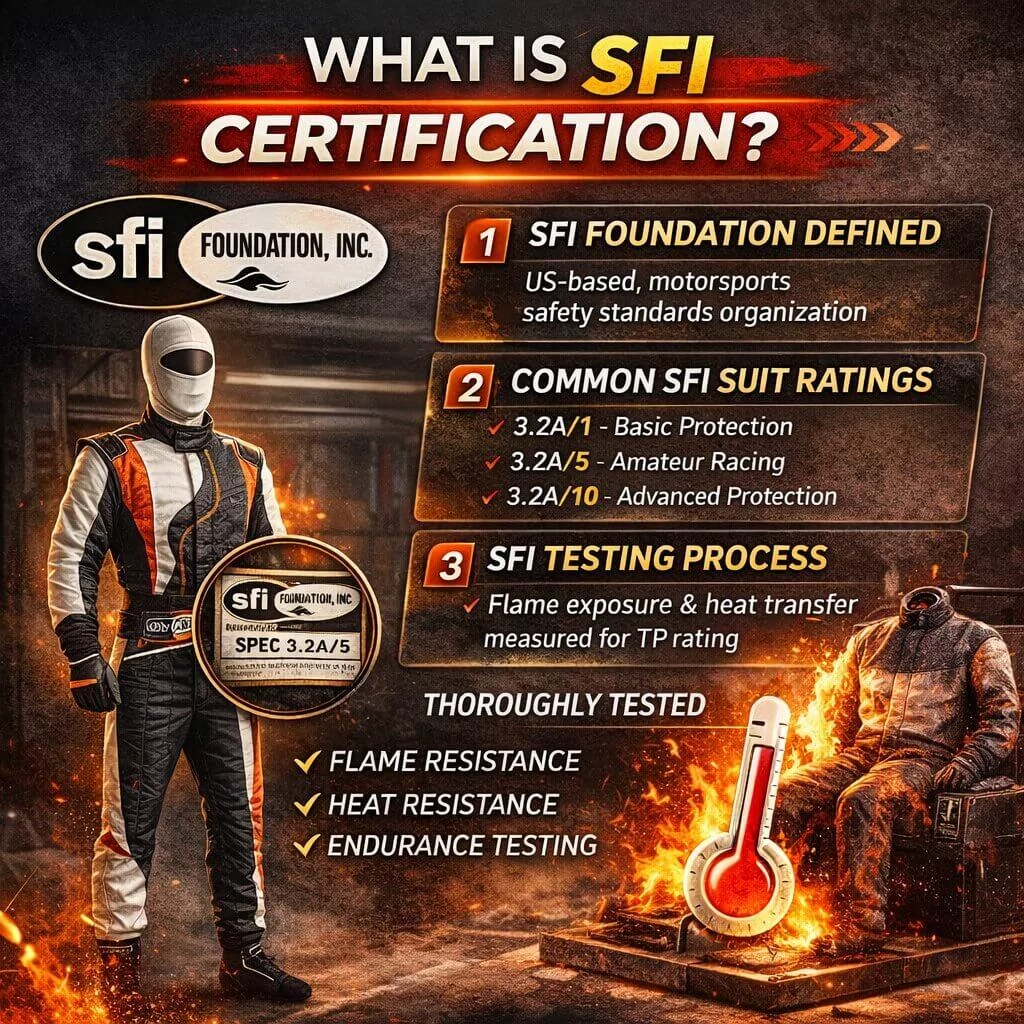
The SFI Foundation (Safety Foundation Inc.) is a U.S.-based organization that develops and manages safety standards primarily for North American motorsports, including NASCAR, NHRA, SCCA, and many grassroots series.
SFI standards are widely accepted across:
Drag racing
Stock car racing
Autocross and club racing
Track day events (depending on organizer rules)
SFI Suit Ratings Explained
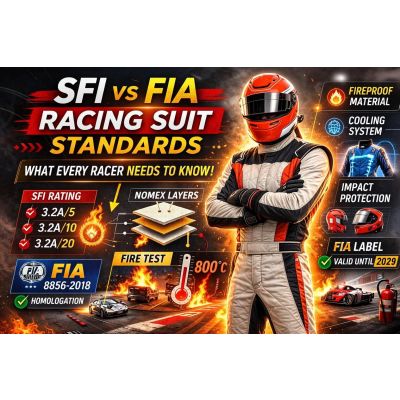
SFI fire suits follow Spec 3.2A, with different protection levels indicated by a number:
SFI 3.2A/1 – Entry level, minimal fire protection
SFI 3.2A/5 – Most common for amateur racing
SFI 3.2A/10 – Higher protection, endurance events
SFI 3.2A/15+ – Professional and extreme conditions
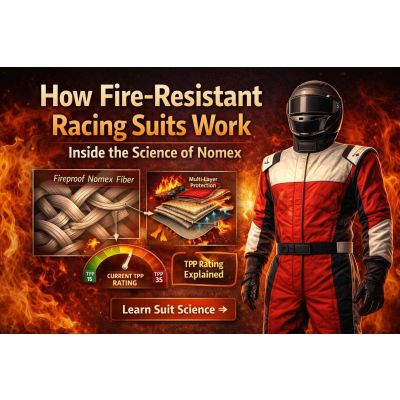
Each higher rating provides longer Thermal Protective Performance (TPP), meaning more seconds of protection before second-degree burns occur.
How SFI Tests Fireproof Suits
SFI certification is based on:
Controlled flame exposure
Heat transfer measurement
Fabric self-extinguishing behavior
Our suits are tested as a system, including outer shell, lining, and seams. Once approved, the manufacturer must submit ongoing compliance samples to maintain certification integrity.
What Is FIA Certification?
FIA’s Role in Global Motorsports
The Fédération Internationale de l’Automobile (FIA) is the governing body for international motorsports, including Formula racing, GT series, endurance racing, and rally events.
FIA standards are mandatory in:
Formula series
GT racing
Rally (WRC, regional rally)
Most international championships
FIA 8856-2000 vs FIA 8856-2018
There are two major FIA suit standards still seen today:
FIA 8856-2000
Older standard
Still accepted in some regional series
Generally thicker, heavier suits
FIA 8856-2018
Current global standard
Improved heat resistance
Lighter, more breathable construction
Mandatory for most professional events
If you’re racing internationally or planning future upgrades, FIA 8856-2018 is the safest long-term choice.
FIA Homologation Labels Explained
Every FIA-approved suit includes:
A woven hologram label
Homologation number
Standard reference (e.g., FIA 8856-2018)
Expiry year
Race officials check this label during technical inspection. If it’s missing, altered, or expired, the suit is not legal for competition.
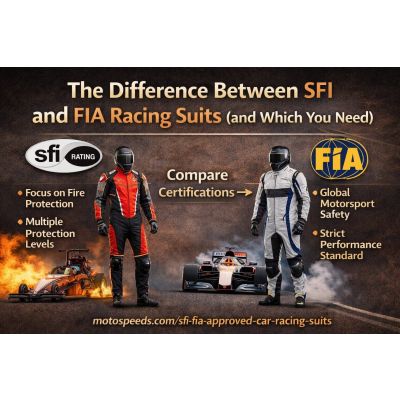
SFI vs FIA: Key Differences Racers Should Know
| Feature | SFI | FIA |
|---|---|---|
| Governing Body | SFI Foundation (USA) | FIA (International) |
| Common Use | Drag, NASCAR, club racing | Formula, GT, Rally |
| Rating System | 3.2A/1 – 3.2A/20 | 8856-2000 / 8856-2018 |
| Expiry | Typically no fixed expiry | Mandatory expiry |
| Global Acceptance | Limited | Worldwide |
Important: Some events accept both, while others specify one only. Always check your series rulebook.
Fireproof Suits: Materials, Construction & Protection
What “Fireproof” Really Means
Racing suits are fire-resistant, not fire-immune. They are designed to:
Resist ignition
Self-extinguish when flames are removed
Delay heat transfer to the skin
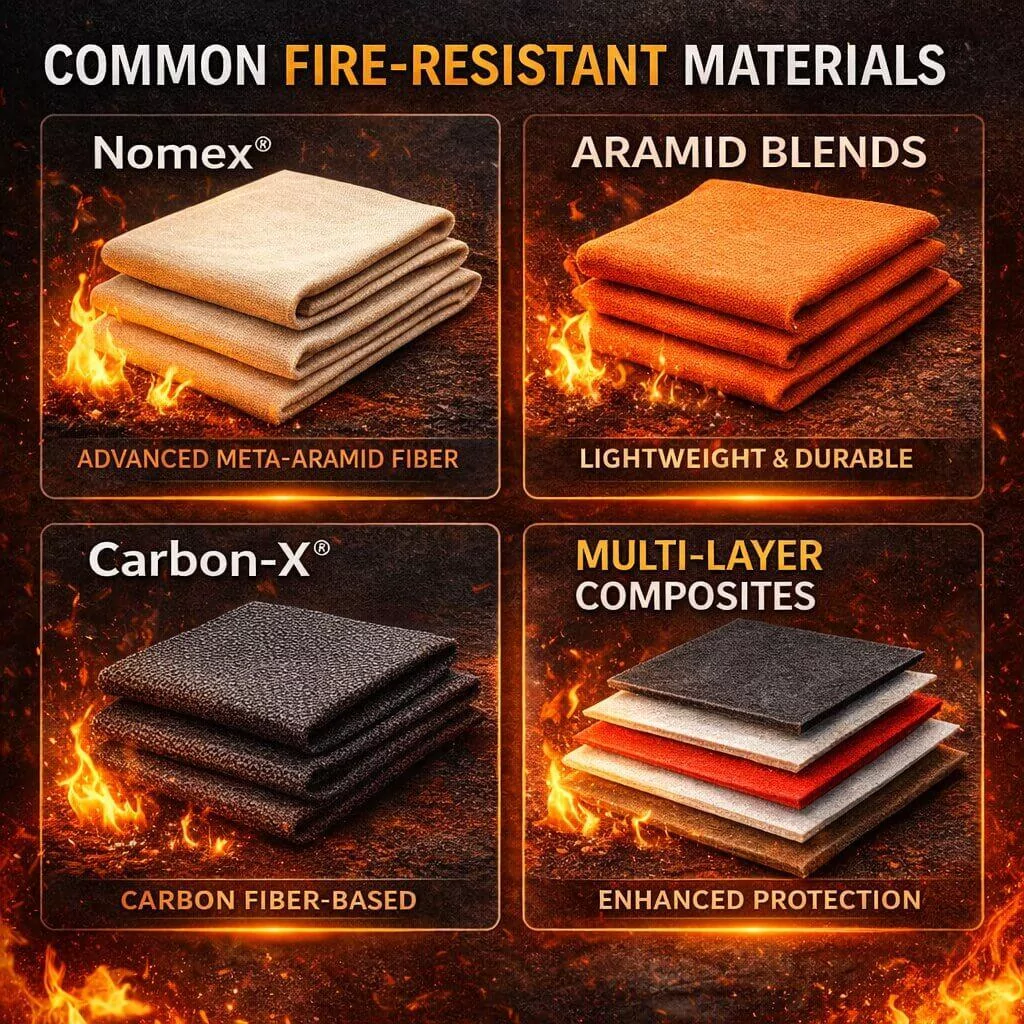
Common Fire-Resistant Materials
Nomex® – Industry gold standard
Aramid blends – Lightweight, durable
Carbon-X® – High-heat tolerance
Multi-layer composites – Enhanced protection
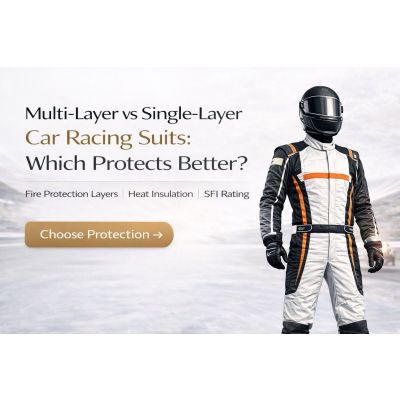
Higher-rated suits usually combine multiple layers, increasing protection without sacrificing mobility.
Stitching, Seams & Fit Matter
Certification covers more than fabric:
Fire-resistant thread
Reinforced seams
Ergonomic panel design
Stretch zones placed away from heat-critical areas
A certified suit that fits poorly can still compromise safety. Custom-fit suits reduce excess air gaps and improve thermal performance.
How Homologation Works (And Why It Expires)
What Is Homologation?
Homologation is the formal approval process confirming that a product meets defined safety standards at the time of manufacture.
Why FIA Suits Expire
Materials degrade due to:
UV exposure
Sweat and oils
Repeated washing
Mechanical stress
FIA assigns expiration dates to ensure ongoing protection. Using an expired suit means unknown performance in a fire.
Choosing the Right Certified Racing Suit
When selecting racing gear, ask these questions:
What series am I racing in now?
Will I move to higher levels later?
Does my organizer accept SFI, FIA, or both?
Do I need single-layer or multi-layer protection?
For entry-level and budget-conscious racers, a properly rated SFI suit is often ideal. For international ambitions, FIA homologation is essential.
You can explore Affordable compliant options here:
Choose Safety That Meets Racing Standards
Explore professionally tested SFI & FIA approved fire-resistant racing suits designed for real competition.
Ready to gear up with confidence?
Common Myths About SFI & FIA Standards
Myth 1: “All racing suits are fireproof.”
Truth: Only certified suits meet tested fire-resistance standards.
Myth 2: “Higher price always means higher protection.”
Truth: Certification rating matters more than branding.
Myth 3: “I can ignore expiration dates.”
Truth: Expired FIA suits can fail scrutineering—and safety.
FAQs
What is the difference between SFI and FIA racing suit standards?
SFI is primarily used in North America with rating levels like 3.2A/5, while FIA is internationally recognized with homologation standards such as FIA 8856-2018.
Are FIA racing suits safer than SFI suits?
Both are safe when properly rated, but FIA standards generally require stricter testing and include expiration to ensure long-term performance.
Do fireproof suits completely prevent burns?
No. They delay heat transfer, giving drivers valuable seconds to escape or be rescued.
Can I use an SFI suit in FIA races?
Usually no. FIA events typically require FIA homologation unless explicitly stated otherwise.
How long does an FIA racing suit last?
Most FIA suits expire after a set number of years listed on the homologation label.
Conclusion
Understanding SFI and FIA racing suit standards is essential for every racer—rookie or professional. These certifications aren’t marketing labels; they are life-saving benchmarks backed by real testing and decades of motorsport experience.
Choosing the right fireproof suit, with valid homologation and proper fit, ensures compliance, confidence, and critical protection when it matters most.