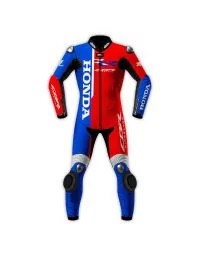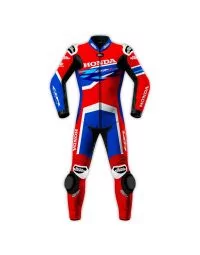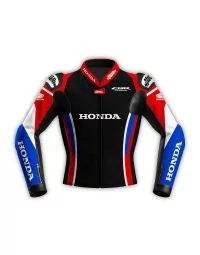
For any serious track rider, the arrival of summer brings a bittersweet reality. While the asphalt is sticky and the grip is at its peak, the temperature inside a cowhide leather suit can quickly climb to dangerous levels. Riding a high-performance machine like the Honda RC213V-S in 90°F heat isn’t just a test of your lap times—it’s a test of your physical endurance.
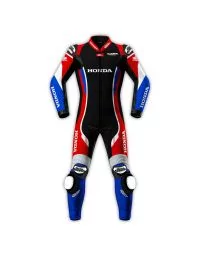
Heat exhaustion is the silent predator of the racetrack. It slows your reaction times, clouds your judgment, and leads to muscle cramps at the very moment you need precision. At Motospeeds, we’ve spent years engineering solutions for this exact problem. In this guide, we’ll explore the science of thermal regulation and why a properly ventilated suit, such as our Honda Racing Suit, is the most important "performance mod" you can buy for your summer season.
1. The Physics of Perforation: Laser-Cut Precision
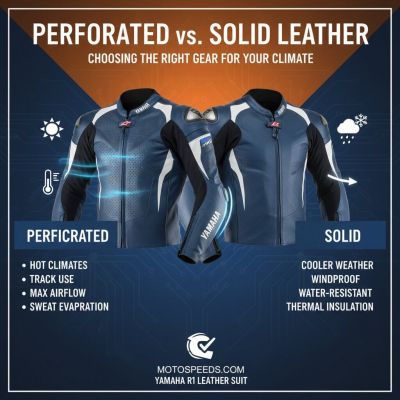
The primary way a leather suit keeps you cool is through perforation. However, not all holes are created equal. In lower-quality gear, holes are often punched haphazardly, which can weaken the structural integrity of the hide.
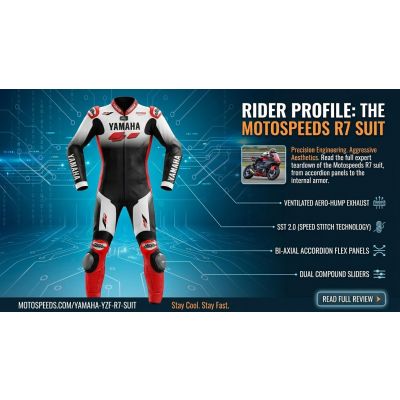
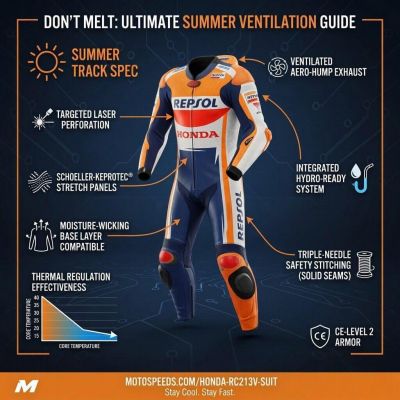
Our utilizes targeted laser perforation. By using high-intensity lasers, we can create thousands of microscopic "ventilation ports" in areas that are not primary impact zones—such as the chest, inner thighs, and stomach.
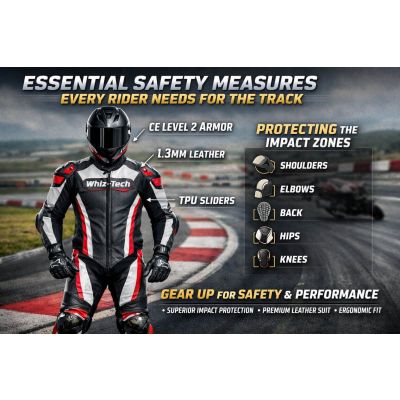
Why it matters: As you accelerate down the straightaway, high-pressure air is forced through these tiny holes. This air hits your base layer and creates "evaporative cooling," pulling heat away from your skin. By keeping the high-stress areas (shoulders, hips, and knees) solid, we maintain the suit's 1.3mm abrasion-resistance rating while allowing the rider to breathe.
2. The Exhaust System: Aero-Hump Ventilation
Most riders think the "hump" on the back of the Honda RC213V Suit is purely for aerodynamics. While it does smooth out airflow coming off the helmet, in a professional-grade summer suit, it also serves as an exhaust port.
Hot air naturally rises and gets trapped against the rider's spine. A ventilated aero-hump features intake scoops at the top and exhaust vents at the rear. This creates a "Venturi effect"—the fast-moving air passing over the hump literally sucks the hot air out from inside the suit. This prevents the "greenhouse effect" that often occurs during slow-speed technical sections or while waiting in the pit lane.
3. Material Science: Stretch Panels and Airflow
Leather doesn't stretch, and it certainly doesn't breathe well on its own. To combat this, elite race suits incorporate Schoeller-Keprotec® or high-tenacity elasticated stretch panels.
In our Honda RC213V design, these panels are strategically located in the underarms, crotch, and calves. While their primary job is to allow for the massive body transitions required on a Honda superbike, they also act as secondary ventilation zones. These fabrics are far more porous than leather, allowing heat to escape from the body's natural "hot zones."
4. The Role of Base Layers: Completing the Circuit
You can have the most ventilated suit in the world, but if you are wearing a 100% cotton t-shirt underneath, you will still overheat. Cotton is a "sponge" for sweat; it holds moisture against your skin, making you feel heavy and clammy.
To get the most out of your Honda matching gear, you must wear a technical moisture-wicking base layer. These synthetic fabrics move sweat to the outer surface of the base layer, where the air coming through the suit's perforations can evaporate it instantly. This keeps your skin dry and prevents the suit from sticking to you, which also makes it much easier to peel off after a grueling session.
5. Customization: The Motospeeds E-E-A-T Advantage
As an authoritative manufacturer of bespoke racing gear, Motospeeds understands that every rider has a different "thermal profile." Some riders run hot, while others prefer a bit more wind protection.
Through our Complete Custom service, we allow you to choose the level of perforation for your suit.
Summer Spec: Full chest, thigh, and back perforation for maximum airflow.
Mid-Season Spec: Partial perforation on the chest only, maintaining more warmth for spring/autumn mornings.
Hydro-Ready: We can integrate a hydration bladder into the aero-hump of your RC213V suit, allowing you to drink while riding—a critical feature for preventing heat stroke during 30-minute sessions.
6. Safety Without Compromise
A common concern is: “Does more ventilation mean less safety?” The answer is no—if the suit is engineered correctly. At Motospeeds, we use triple-needle safety stitching with bonded nylon thread. We ensure that no perforations are placed within 1cm of a structural seam. This ensures that in the event of a slide, the leather maintains its tensile strength, and the suit does not "tear" along the perforation lines.
Conclusion: Stay Cool, Stay Fast
Riding at the limit requires 100% of your mental bandwidth. If 20% of your brain is occupied with how hot and uncomfortable you are, you are leaving lap time on the table—and increasing your risk of a mistake.
The isn’t just a tribute to the legendary MotoGP machine; it is a cooling system designed to keep you sharp when the track temperature is soaring. Invest in proper ventilation this summer and experience the difference between surviving a track day and dominating it.