
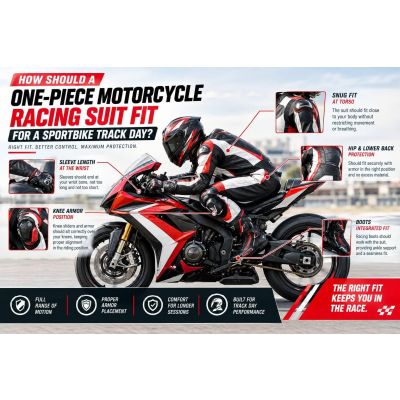
You've decided to take your sportbike to the track for a track day, or you're finally ready to move beyond street gear. Now you're staring at racing suits online, reading reviews, trying on samples, and wondering: does this actually fit right? A racing suit that feels loose in the showroom might shift dangerously during a high-speed slide. A suit that feels snug while standing might restrict your arms when you're gripping the handlebars in an aggressive lean. The difference between a suit that fits well and one that doesn't can mean the gap between effective protection and wasted money.
Fit is not a luxury detail for racing suits. Fit is a safety system. Armor must stay in place during impact, not just while you're riding. Seams must not gape open when you're in your riding position. Leather must not bunch or fold in ways that create thin spots or pressure points. A one-piece racing suit that fits correctly protects you better, keeps you more comfortable during long sessions, and lasts longer because the leather wears evenly. This guide walks you through what good fit actually looks like, how to measure yourself accurately, what to expect when you try on a suit, and how to know whether standard sizing or custom construction is the right choice for your body and your riding style.
Quick Buying Advice:
A racing suit fits correctly when the sleeves reach your wrist with your arms extended and elbows slightly bent, the torso has no excess fabric bunching when you're in your racing crouch, and armor sits snugly over your knees and hips without sliding. Try the suit on in your riding position, not standing upright. If your shoulders feel tight when gripping handlebars, the suit is too small. If there are gaps at the waist or hips when you lean forward, the suit is too large. Measure your chest, waist, hips, inseam, and arm length before ordering, and compare against the manufacturer's size chart, not your street clothing size.

- What Should Riders Know Before Buying a Racing Suit?
- How to Choose Gear Based on Your Riding Style
- What Safety Features Should Buyers Check?
- How Fit and Sizing Affect Comfort and Protection
- Which Materials and Construction Details Matter?
- Standard Size vs Custom Size: Which Should You Choose?
- Final Buying Advice from MotoSpeeds
What Should Riders Know Before Buying a Racing Suit?
A one-piece racing suit is built for a specific job: protecting you during high-speed sliding on a track or road course. It is not built for commuting, casual street riding, or everyday comfort. Understanding this distinction shapes every buying decision that follows.
A one-piece suit keeps all your protective armor in one connected system. When you slide, the suit moves as one unit with your body. Armor stays in place because it is sewn to the suit, not just tucked into pockets. Seams are reinforced with bar tacks and heavy stitching to prevent separation during impact. The leather is typically thicker and more tightly fitted than street gear because the suit's job is to maximize abrasion resistance and impact protection, not accommodate a wide range of body shapes or riding positions.
This design makes one-piece suits excellent for track days, club racing, and road courses where speeds are high and crashes often involve sliding. It makes them impractical for commuting, because you cannot wear them over normal clothing, you cannot step off easily at traffic lights, and the tight fit that protects you on track becomes fatiguing after an hour of stop-and-go riding.
A sportbike rider preparing for their first track day should expect a racing suit to feel noticeably different from street leather. The fit will be tighter. The sleeves will be shorter to keep your arms in a racing crouch. The waist and hips will have minimal extra fabric. The suit will feel restrictive when you stand upright — that is correct. When you're on the bike in your racing position, the suit should feel snug but not strangling.
Riders who are still deciding between a one-piece and a two-piece suit should know this: a one-piece suit offers better armor integration, more consistent protection, and less risk of armor migration during a crash. A two-piece suit offers flexibility and versatility — you can wear the jacket over street clothes, or pair it with different bottoms. For pure track-day use, a one-piece suit is the stronger choice. For a rider who wants to track their bike some days and commute other days, a two-piece suit might be more practical, even if the protection is slightly less optimized.
How to Choose Gear Based on Your Riding Style
Your riding style and typical speeds determine what level of protection you actually need, and that affects what suit features matter most to you.
A beginner track-day rider attending their first event at a club track is usually riding at 6–7 tenths of their capability and the bike's capability. Speeds might reach 100–120 mph on straights, but the rider is learning lines and building confidence. For this rider, a one-piece suit with CE Level 2 armor at the knees and hips is appropriate. The suit should have good abrasion resistance — 1.0 mm cowhide or thicker — and secure armor pockets that will not let armor shift. The fit should be snug enough that the suit stays in place, but not so tight that the rider is exhausted after twenty minutes of riding.
A club racer or intermediate track-day rider who is pushing harder and spending multiple sessions on track needs a higher standard. Crashes at 7–8 tenths are more likely, and speeds are higher. This rider benefits from a suit with CE Level 2 armor, reinforced stitching, and possibly a back protector pocket. The fit needs to be precise because the rider will be in the same position for longer periods, and any bunching or pressure points will become painful after an hour. This is where custom sizing starts to become valuable if the rider has non-standard proportions.
A road racer or club racer competing in organized events should prioritize armor quality and suit construction above all else. These riders are pushing 9–10 tenths, and crashes often happen at very high speeds. A suit with CE Level 2 armor, reinforced seams, a quality back protector, and a fit that is dialed in to the rider's exact body proportions is worth the investment. Custom sizing is often the right choice here because the protection and comfort improvements justify the cost.
A street-based sportbike rider who occasionally attends a track day but rides on the road most of the time faces a different calculation. A one-piece suit is not practical for their primary use. A two-piece suit with good armor and a close fit is a better choice. If they decide to buy a one-piece suit specifically for track days, they should accept that it will be a specialized piece of gear, not an everyday option.
What Safety Features Should Buyers Check?
Armor is the most visible safety feature, but fit, materials, and construction matter just as much. A suit with excellent armor that does not fit correctly will not protect you well because the armor will shift during a crash. A suit made from thin, low-quality leather will not provide adequate abrasion resistance even if the armor is certified.
Start with armor certification. Look for CE certification under EN 1621-1 (for impact protectors at knees and hips) and EN 1621-2 (for back protectors). CE Level 2 armor is significantly more protective than Level 1. Level 2 armor absorbs more impact energy under the same test conditions. For track days, CE Level 2 is the minimum standard. Do not buy a suit with Level 1 armor if you are planning to ride at speed or attend a track event.
Check the armor placement. Knee armor should cover the entire kneecap and extend slightly above and below. Hip armor should sit over the hip bone and extend toward the side of the thigh. If armor is positioned too high, too low, or too far back, it will not protect the areas that need it most. Armor that is sewn into pockets is better than armor that sits loose, because sewn armor cannot migrate during a crash.
Examine the leather thickness and quality. Racing suit leather is typically 1.0–1.3 mm cowhide or 0.8–1.0 mm kangaroo leather. Cowhide is more common, more widely available, and more affordable. Kangaroo leather is lighter and stronger per millimeter, but it is more expensive and more difficult to repair. For a first racing suit, cowhide is a practical choice. For a rider who is upgrading or who prioritizes lightweight gear, kangaroo leather is worth considering.
Look at seam reinforcement. Racing suit seams should have bar tacks (small perpendicular stitches that lock the seam) at stress points like the shoulders, armpits, and inseams. The stitching thread should be heavy-duty nylon or polyester, not standard sewing thread. Seams should be double-stitched or triple-stitched, not single-stitched. When you examine a suit, run your finger along the seams. If they feel loose or thin, the suit will not hold up to a crash.
Check the zipper and fasteners. The main zipper connecting the jacket and pants should be a heavy-gauge YKK or similar quality zipper, not a cheap plastic zipper. It should have a locking slider so it cannot accidentally open during riding. Wrist and ankle zippers should be sturdy and easy to operate while wearing gloves. Velcro closures should be industrial-strength, not the thin adhesive kind that peels off after a few washes.
Verify that the suit includes or has pockets for a back protector. A back protector is not required for track days at most clubs, but it is strongly recommended. A suit designed with a back protector pocket will have reinforced stitching and proper positioning. Adding a back protector to a suit that was not designed for it can create pressure points and fit issues.
How Fit and Sizing Affect Comfort and Protection
Fit is where most riders make their biggest mistakes, and it is where the difference between a good purchase and a bad one becomes clear.
A suit that is too large will shift during a crash. Gaps will open at the waist, hips, and shoulders. Armor will migrate away from the body parts it is supposed to protect. You will feel loose and unstable on the bike, especially during hard braking or acceleration. A suit that is too tight will restrict your movement, fatigue your shoulders and arms, and create pressure points that become painful after thirty minutes of riding. You will also struggle to get in and out of the suit, which matters when you are already hot and tired at the track.
The correct fit is snug but not restrictive. When you put on the suit while standing, it should feel tight. When you crouch into your racing position on the bike, the suit should feel comfortable. Your shoulders should move freely when you grip the handlebars. Your hips and knees should feel supported but not squeezed. The sleeves should reach your wrist when your arms are extended and your elbows slightly bent. The inseam should be long enough that you do not feel stretched, but short enough that there is no excess fabric bunching at the ankles.
To measure yourself accurately, wear the base layers you will wear under the suit (usually a thin synthetic shirt and pants). Measure your chest at the fullest point. Measure your waist at your natural waist, not at your hips. Measure your hips at the fullest point. Measure your inseam by standing barefoot with your legs slightly apart and measuring from your crotch to your ankle. Measure your arm length from the center of your back, across your shoulder, down your arm to your wrist. Write these measurements down and compare them to the manufacturer's size chart.
Do not use your street clothing size as a reference. A racing suit sized for a 42 chest does not correspond to a 42 jacket from a regular clothing brand. Racing suits are cut differently. They are tighter in the shoulders, shorter in the sleeves, and narrower in the waist. A rider who wears a 42 regular jacket might wear a 50 or 52 in a racing suit, or they might fit a 48 depending on the brand and cut.
When you try on a suit, put it on fully and zip it completely. Sit on a chair or a mock bike seat and lean forward into your racing position. This is the position where you will spend hours on track. Does the suit feel comfortable? Are there gaps at the waist? Does the armor sit correctly over your knees? Can you move your arms freely? Can you grip the handlebars without your shoulders feeling tight? Spend at least five minutes in this position. If you feel any pinching, pressure, or restriction, the suit does not fit correctly.
Check the sleeves carefully. When your arms are extended and your elbows slightly bent, the sleeves should reach your wrist. If the sleeves are too short, your wrists will be exposed. If the sleeves are too long, fabric will bunch at your wrists and create pressure points. The sleeves should feel snug around your biceps and forearms, not loose.
Examine how the suit fits at the shoulders. When you grip the handlebars and lean forward, your shoulders should not feel tight or restricted. If you feel tension or if your shoulders are being pulled back, the suit is too small. This is one of the most common fit problems. A rider buys a suit that fits their chest measurement but does not account for their shoulder width, and then discovers on the track that they cannot get into their racing position comfortably.
Look at the waist and hips when you are in your racing position. There should be no excess fabric bunching at the sides or back. The suit should be snug enough that it moves with your body, not loose enough that it wrinkles or folds. If there are visible folds or gaps, the suit is too large.
Common buying mistakes happen when riders choose the wrong size. A rider might order a size based on their street clothing or based on a single measurement without comparing the full size chart. They might choose a size that feels comfortable while standing, without testing it in their racing position. They might assume they can adjust fit by tightening straps or wearing different base layers, when the real problem is that the suit is the wrong size. Once you have chosen a size and tried it on, do not second-guess yourself. If the fit is not right, exchange it for a different size or consider custom sizing.
Which Materials and Construction Details Matter?
Material quality and construction directly affect how long the suit lasts, how well it protects you, and how comfortable it is to wear.
Leather thickness is measured in millimeters. A 1.0 mm cowhide suit offers good abrasion resistance and is standard for most racing suits. A 1.3 mm suit offers more protection but is heavier and stiffer. A 0.8 mm kangaroo leather suit offers similar protection to a 1.0 mm cowhide suit but is lighter and more flexible. For a rider who is going to wear the suit for multiple hours on a hot track day, weight and flexibility matter. For a rider who prioritizes pure protection, thicker leather is better.
Leather quality varies significantly between manufacturers. High-quality leather is uniform in thickness, has consistent grain, and resists tearing and abrasion better than low-quality leather. Low-quality leather has thin spots, uneven grain, and degrades faster. When you examine a suit, look at the leather surface. It should feel smooth and consistent. If you see thin spots, discoloration, or rough patches, the leather quality is questionable.
Lining material affects comfort and durability. A mesh lining allows air to circulate and helps the suit dry faster if it gets wet. A smooth fabric lining reduces friction and makes the suit easier to put on and take off. A cheap lining will tear easily and will not last as long as the leather. Quality suits have lining that is stitched securely and will not separate from the leather during normal use or after a crash.
Stitching quality is critical. Look at the seams on the inside of the suit. The stitches should be small, tight, and evenly spaced. The thread should be heavy-duty and the same color as the leather so you cannot see gaps between stitches. Seams should have bar tacks at stress points. If you see loose stitches, gaps, or thin thread, the suit is not well-made.
Zipper quality matters because a broken zipper makes the suit unusable. YKK zippers are the industry standard for quality. A racing suit should have a heavy-gauge YKK zipper connecting the jacket and pants, and quality zippers at the wrists and ankles. The zipper should be easy to operate, should lock securely, and should not catch or jam.
Velcro closures on cuffs and collars should be industrial-strength. Cheap Velcro loses its grip after a few uses. Quality Velcro will hold securely through many wash cycles and will not peel or separate. When you examine a suit, test the Velcro. It should feel thick and should grip firmly.
When is it worth paying more for better materials and construction? If you are a beginner buying your first racing suit and you plan to attend a few track days per year, a mid-range suit with good armor and solid construction is sufficient. If you are a club racer or a frequent track-day rider who will wear the suit dozens of times per year, a higher-end suit with premium leather, reinforced construction, and excellent armor is worth the investment. The suit will last longer, will protect you better, and will be more comfortable over long riding sessions. If you crash and need repairs, a well-constructed suit is easier and cheaper to repair than a poorly-made suit.
Standard Size vs Custom Size: Which Should You Choose?
Most riders fit into standard sizes. Custom sizing is valuable when your body proportions fall outside the typical range that standard sizes accommodate.
Standard sizes are designed around average proportions. If you have an average chest, average arm length, and average leg length for your height, a standard size will fit you well. Most manufacturers offer sizes from XS to XXL or larger, with multiple options in the chest measurement. If you can find a size that matches your measurements on the manufacturer's size chart, standard sizing is the right choice. It is faster (usually ships within a week), less expensive (typically $200–400 less than custom), and carries no risk of ordering the wrong size.
Custom sizing becomes valuable when you have non-standard proportions. A rider who is very tall and has long arms but a narrow chest might not fit standard sizes well — the sizes that fit the chest will have sleeves that are too short, and the sizes that fit the sleeves will have a chest that is too large. A rider who is short and stocky with short arms but a large chest faces a similar problem. A rider with an unusually long or short inseam relative to their height might not find a standard size that works. A rider who is recovering from an injury and has uneven muscle development might need a custom fit.
Custom sizing involves sending your measurements to the manufacturer, and sometimes having a fitting call with a designer. The manufacturer then builds the suit to your exact specifications. This takes longer (usually 4–8 weeks) and costs more (typically $300–600 more than a standard suit). But if you have non-standard proportions, the result is a suit that fits you perfectly, with armor positioned correctly for your body, and no wasted fabric or pressure points.
To decide between standard and custom, start by measuring yourself accurately and comparing your measurements to the manufacturer's size chart. If you find a size where all your measurements fall within the range, order the standard size. If your measurements fall outside the range, or if different measurements suggest different sizes (for example, your chest suggests a size 50 but your arm length suggests a size 52), custom sizing is worth considering.
Another factor is whether you plan to keep the suit for a long time. If you are buying a suit you will wear for five or more years, custom sizing is a better value because the perfect fit will remain comfortable for all that time. If you are buying a suit for your first track day and you are not sure if you will continue racing, standard sizing is more practical because you can resell it more easily if you decide racing is not for you.
Final Buying Advice from MotoSpeeds
Before you buy a one-piece motorcycle racing suit, make three decisions in order: protection level, fit, and materials.
First, choose your protection level. Decide whether you need CE Level 2 armor (which you do for any track day or high-speed riding) or if Level 1 is sufficient (it is not). Decide whether you want a back protector pocket. Decide what leather thickness you need based on your riding style and how much weight and flexibility matter to you. These decisions are about safety, and they should come before price.
Second, solve the fit problem. Measure yourself accurately. Compare your measurements to the manufacturer's size chart. Try the suit on in your racing position, not standing upright. If the fit is not right, exchange it or consider custom sizing. Do not compromise on fit because you like the color or the price. A suit that does not fit correctly will not protect you well, and it will not be comfortable to wear.
Third, examine the materials and construction. Look at the leather quality, the stitching, the zipper, and the armor. Make sure the suit is well-made and will last through multiple crashes and many miles of riding. A suit that costs $200 more but will last twice as long is a better value than a suit that costs less but falls apart after two seasons.
Riders who want better protection for track and road use can explore our
for gear designed around safety, fit, and high-speed riding performance.Once you have chosen your suit size and protection level, you should also think about gloves and boots that match your suit. A complete race kit — suit, gloves, and boots in matching leather and color — looks cohesive and ensures that all your protective gear meets the same standards. Mismatched gear is not a safety problem, but matched gear shows that you have thought through your entire protective system.
For riders comparing real protective gear and construction details,
shows how armor placement, reinforced seams, and fit work together to protect you on track.The most important step is to try the suit on before you commit to it. If you are ordering online, look for retailers who offer free returns or exchanges so you can try different sizes without risk. If you are buying from a local shop, spend time in the fitting room. Get in your racing position. Grip the handlebars. Lean forward. Make sure the suit feels right for how you will actually use it. A few minutes of careful fitting now will save you the frustration and expense of buying the wrong suit and having to exchange it or resell it later.
FAQs
What is the difference between a racing suit and a street riding jacket?
A racing suit is designed for track use with tight, precise fit that keeps armor in place during slides, reinforced seams that withstand high-impact crashes, and minimal excess fabric. A street jacket prioritizes versatility and comfort for everyday riding, with looser fit that accommodates movement at lower speeds and layering for weather changes. Racing suits offer better protection at high speeds but are impractical for commuting or casual riding because they require a racing crouch position and cannot be worn over street clothes.
How do I know if my racing suit is too tight?
A racing suit is too tight if you feel tension or restriction in your shoulders when you grip the handlebars in your racing position, if your arms feel fatigued after thirty minutes of riding, or if you struggle to get into or out of the suit without help. Some tightness is normal and correct, but you should be able to move your arms freely and breathe normally. If the suit feels like it is pulling you backward or if you cannot reach the handlebars comfortably, it is too small and you should exchange it for a larger size.
Can I wear a racing suit for street riding?
Technically yes, but it is impractical for most riders. A racing suit requires a racing crouch position to fit correctly, which is uncomfortable for street riding at normal speeds. The tight fit makes it difficult to move around at traffic lights or to get on and off the bike easily. The suit will also wear out faster because street riding involves more frequent mounting and dismounting. For street riding, a two-piece suit or a street jacket is more practical. Save the racing suit for the track.
What should I wear under my racing suit?
Wear thin synthetic base layers — a lightweight shirt and pants made from polyester or nylon. Avoid cotton because it retains sweat and becomes heavy when wet. Avoid thick layers because they will make the suit feel too tight. The base layers should be snug but not restrictive. Many riders also wear a thin synthetic undershirt to reduce friction and help with moisture management. In cold weather, you can wear a thin thermal layer, but be aware that this will change how the suit fits, so measure yourself with the layers you plan to wear.
How often should I replace my racing suit?
A well-made racing suit can last 5–10 years with proper care if you do not crash. After a crash, inspect the suit for damage. Small tears in the leather can be repaired. Separated seams can be re-stitched. If the armor is damaged or the zipper is broken, repairs are possible but expensive. Most riders replace their suits when the leather becomes too worn for safety, when repairs are no longer practical, or when they upgrade to a new suit with better protection or fit. How often you ride and whether you crash determines how quickly your suit wears out.
Should I buy a suit with or without a back protector pocket?
Buy a suit with a back protector pocket if you plan to add a back protector later. A suit designed with a back protector pocket has reinforced stitching and proper positioning so the protector stays secure and does not create pressure points. Adding a back protector to a suit that was not designed for it can cause fit issues and discomfort. Back protectors are not required for most track days, but they are recommended for safety. A quality back protector costs $150–300, so if you might want one later, choosing a suit with the pocket built in is the practical choice.
What is the best leather for a racing suit, cowhide or kangaroo?
Cowhide is thicker, more durable, more widely available, and more affordable. Kangaroo leather is lighter, more flexible, and stronger per millimeter. For a first racing suit, cowhide is the practical choice because it offers excellent protection and value. For a rider who prioritizes lightweight gear or who plans to wear the suit for many hours in hot weather, kangaroo leather is worth the extra cost. Both materials offer good protection when properly constructed. The choice depends on your budget, your weight sensitivity, and how much flexibility matters to you.