The Impact Barrier: CE Level 1 vs. Level 2 Armor and When to Upgrade Your Protection
When you're shopping for a new leather motorcycle suit or upgrading your protective gear, you'll see armor labeled CE Level 1 or CE Level 2. Both offer impact protection, but they work differently and protect differently. Understanding the difference between CE Level 1 vs. Level 2 armor helps you buy gear that actually matches your riding style and crash risk. This guide explains what each armor level does, when you need it, and how to choose the right protection for your body and your riding goals.
Quick Answer: CE Level 1 vs. Level 2 Armor
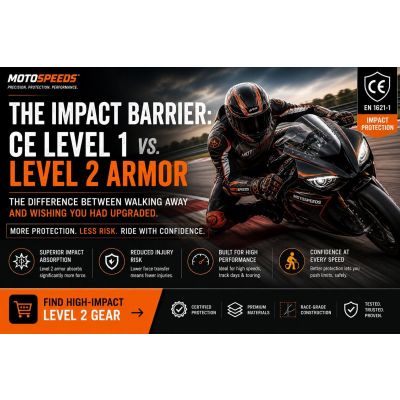
CE Level 1 armor absorbs impact energy at speeds up to 5.5 meters per second and is best for casual street riding and beginner riders. CE Level 2 armor protects at higher speeds (up to 7 meters per second) and handles repeated impacts better, making it more suitable for track riding, sportbike riding, and experienced riders. Level 2 armor is thicker, denser, and harder. Level 1 is lighter and more comfortable for long rides. The choice depends on your crash risk, riding speed, and how much protective coverage you prioritize over comfort.
Table of Contents
- What Does CE Armor Mean for Rider Safety?
- What Is CE Level 1 Armor and When Is It Enough?
- What Is CE Level 2 Armor and Who Needs It?
- How Impact Armor Helps During a Crash or Slide
- Why Fit and Placement Matter More Than You Think
- When Should You Upgrade to Level 2 Armor?
- Common Mistakes Riders Make When Choosing Armor
- Final Buying Advice from MotoSpeeds
What Does CE Armor Mean for Rider Safety?
CE armor is protective padding tested and certified under European safety standards. CE stands for Conformité Européenne, which means the armor has been independently tested for impact absorption and energy management. When you buy motorcycle gear with CE armor, the manufacturer has proven the padding reduces impact force reaching your skin and bones.
CE armor testing uses a mechanical test machine, not a human body. The machine drops a weighted head-shaped tool onto the armor from different heights. The test measures how much energy the armor absorbs and how much force still reaches whatever is underneath. Two main test speeds exist: Level 1 armor (lower impact energy) and Level 2 armor (higher impact energy).
Think of armor like a car's crumple zone. The padding compresses and absorbs crash energy instead of your body taking the full force. Better armor compresses more effectively, stays in place longer, and protects through multiple impacts. But armor has limits. Even the best CE Level 2 armor cannot prevent all injuries at all speeds.
What Is CE Level 1 Armor and When Is It Enough?
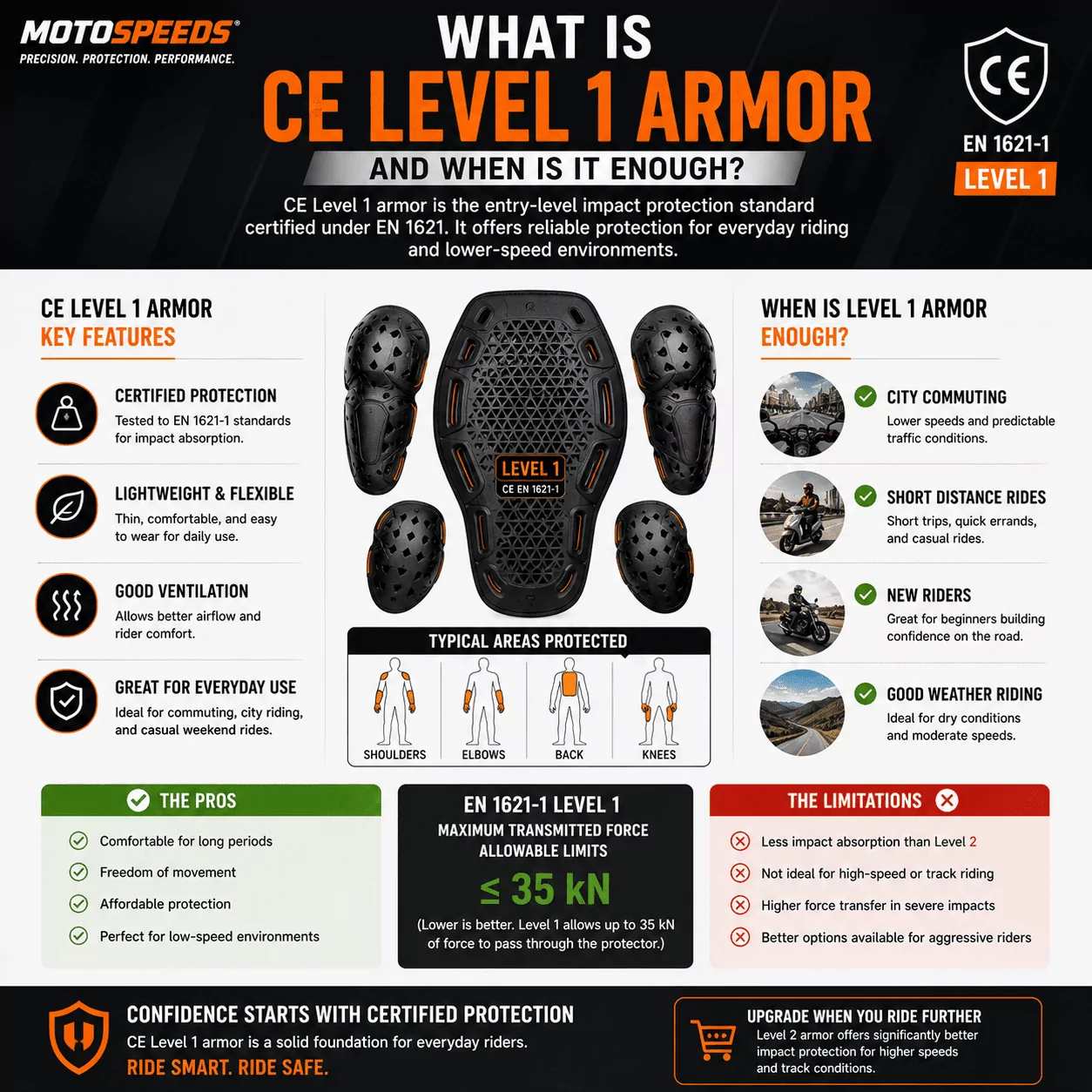
CE Level 1 armor absorbs impact energy at speeds up to 5.5 meters per second (about 12 mph). This sounds slow, but many street riding crashes happen at moderate speeds, especially in traffic, parking lot incidents, and low-speed slides. Level 1 armor is lighter, thinner, and more flexible than Level 2, which makes it more comfortable for all-day wearing.
Level 1 armor typically costs less and is found in entry-level leather suits, jackets, and protective gloves. It's a good starting point for beginner riders who value comfort and fit over maximum protection. Many casual street riders find Level 1 armor adequate because they ride slower speeds and have lower crash risk.
But Level 1 armor has real limits. If you crash at 25 mph or higher, or if you slide multiple times on asphalt, Level 1 padding may not absorb enough energy to prevent significant injury. Track riders, sportbike riders, and road racers should consider Level 2 armor because they face higher-speed impacts and repeated slide risk. Summer riding in lighter gear sometimes feels more comfortable, but comfort and safety aren't always aligned. If you're choosing between light and protected, remember that a crash doesn't care about comfort.
What Is CE Level 2 Armor and Who Needs It?
CE Level 2 armor absorbs impact energy at speeds up to 7 meters per second (about 15.6 mph). This higher test speed means the armor is engineered to handle harder impacts and transfer less force to your body. Level 2 armor is thicker, denser, and made from stiffer materials that compress more slowly and recover faster. It can handle multiple impacts better than Level 1.
Track-day riders, club racers, and sportbike riders should prioritize Level 2 armor. These riders spend extended time at higher speeds, lean into turns at aggressive angles, and face greater crash probability. Knee, elbow, shoulder, and hip protection become more important at these speeds. A slide at 35 mph versus 15 mph is dramatically different for impact energy and abrasion risk.
Level 2 armor costs more and weighs more. On long rides or in warm weather, thicker armor can feel less comfortable. Some riders struggle with fit when armor gets thicker. But the protection gains are worth the trade-off if you're racing, doing track days, or riding fast sportbikes regularly. Think of it like a professional racing suit versus a casual cruiser jacket. Different purposes, different armor choices.
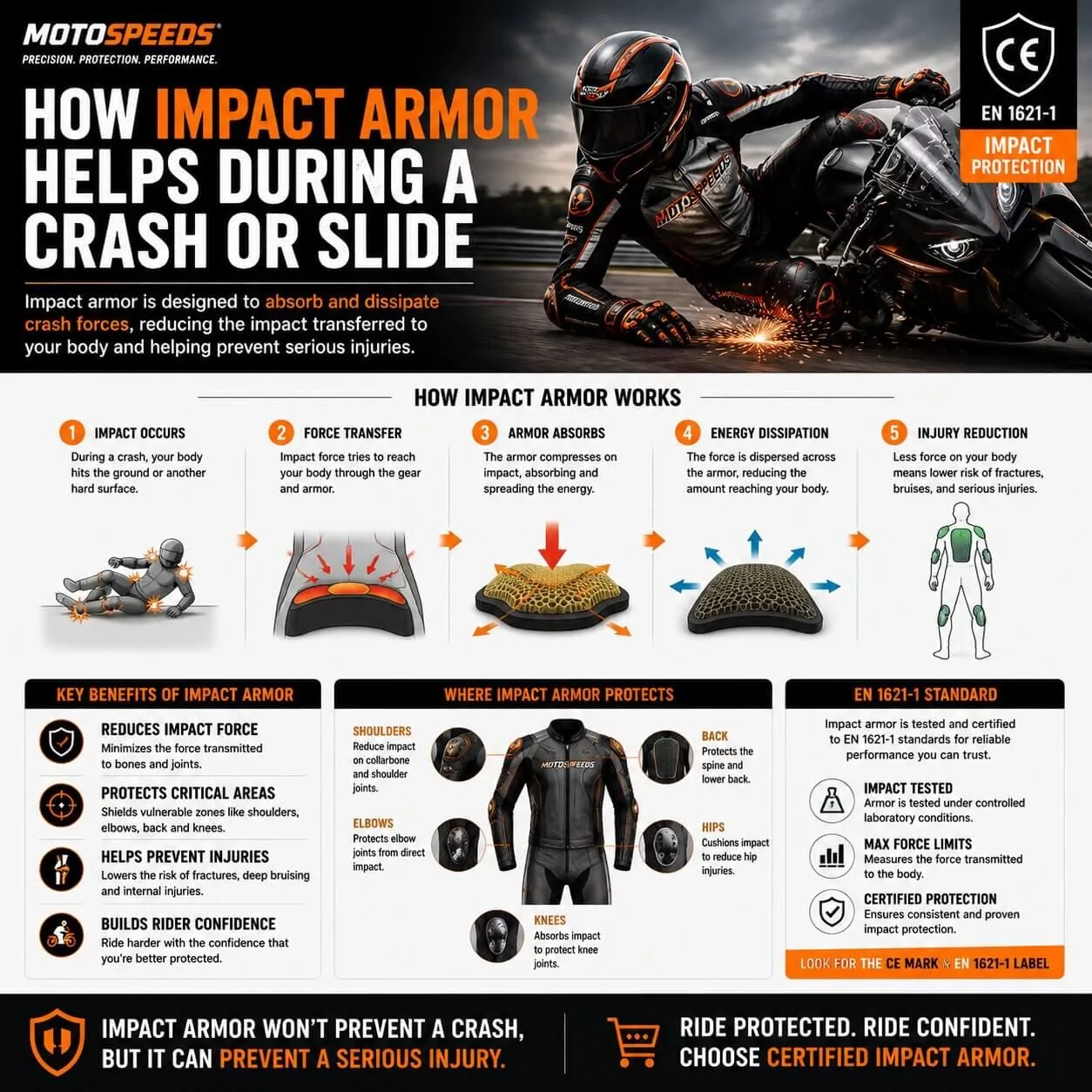
How Impact Armor Helps During a Crash or Slide
Real crashes happen in different ways, and armor performance matters differently in each scenario.
Street Riding Crash: You're merging onto a highway and a car cuts you off. You brake hard and the bike slides out at 20 mph. Your left shoulder, elbow, and hip hit the asphalt. You're sliding on pavement. Good Level 1 armor on your shoulder and elbow will absorb the direct impact. Your body takes less force than it would without armor. But the abrasion (skin scraping from sliding friction) is also important. Impact protection and abrasion protection are separate things. You need both.
Track-Day Incident: You're pushing a sportbike through turn three at 45 mph. Your lean angle gets too aggressive and your elbow and knee touch down. You're sliding at significant speed. Level 2 armor on both joints will compress and absorb the impact force. The denser material handles the higher energy better than Level 1 would. But even Level 2 armor can't prevent broken bones if the impact is severe enough. The armor reduces injury severity, not eliminate it entirely.
Multi-Impact Scenario: Some crashes involve multiple hits. Your knee hits pavement, you roll, your hip hits next, then your shoulder. Level 2 armor's denser construction recovers faster after the first impact, keeping it ready to protect the second and third impacts. Level 1 armor may compress completely on the first impact and offer less protection on the second.
The real-world lesson: armor works best when it absorbs impact energy before your bones and organs take that force. But armor can only do so much. At very high speeds or severe impacts, injury still occurs. The best safety strategy combines good armor, good riding skills, good bike control, and smart speed selection.
Why Fit and Placement Matter More Than You Think
A suit with Level 2 armor that fits poorly might protect worse than a Level 1 suit that fits perfectly. Here's why: armor only protects if it stays in place during a crash. If your suit is too loose, the armor shifts away from your impact zones. If it's too tight, you move around inside the suit and the armor misaligns with your actual joints.
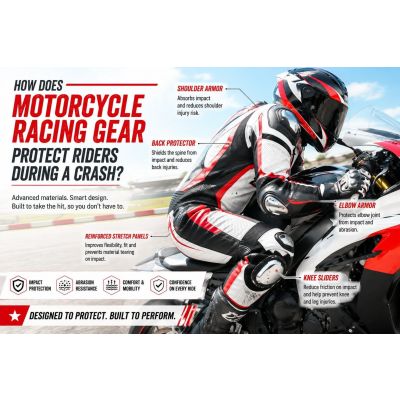
Your shoulders, elbows, knees, hips, and spine are your vulnerable impact zones. Armor must cover these areas completely and stay centered on these joints. When you're in a riding position, your posture changes where these joints sit. A suit that fits right when standing may shift wrong when you're crouched over the bars at 60 mph. This is why custom-fit suits and pre-fit armor offer better protection than off-the-rack generic gear.
Riders often choose armor based on comfort first, protection second. You'll feel the difference between Level 1 and Level 2 armor immediately. Level 2 is stiffer and less flexible. It can feel restrictive on long rides or in summer heat. But if you're a track rider or high-speed sportbike rider, that trade-off is necessary. The suit exists to protect you during a crash, not to be perfectly comfortable every single minute of riding.
Riders shopping for new protective gear should look for suits where armor placement aligns with your actual riding position on your specific motorcycle. Brand-specific protective gear for racing suits, track jackets, and sportbike suits are engineered around typical aggressive riding postures, not casual street riding positions.
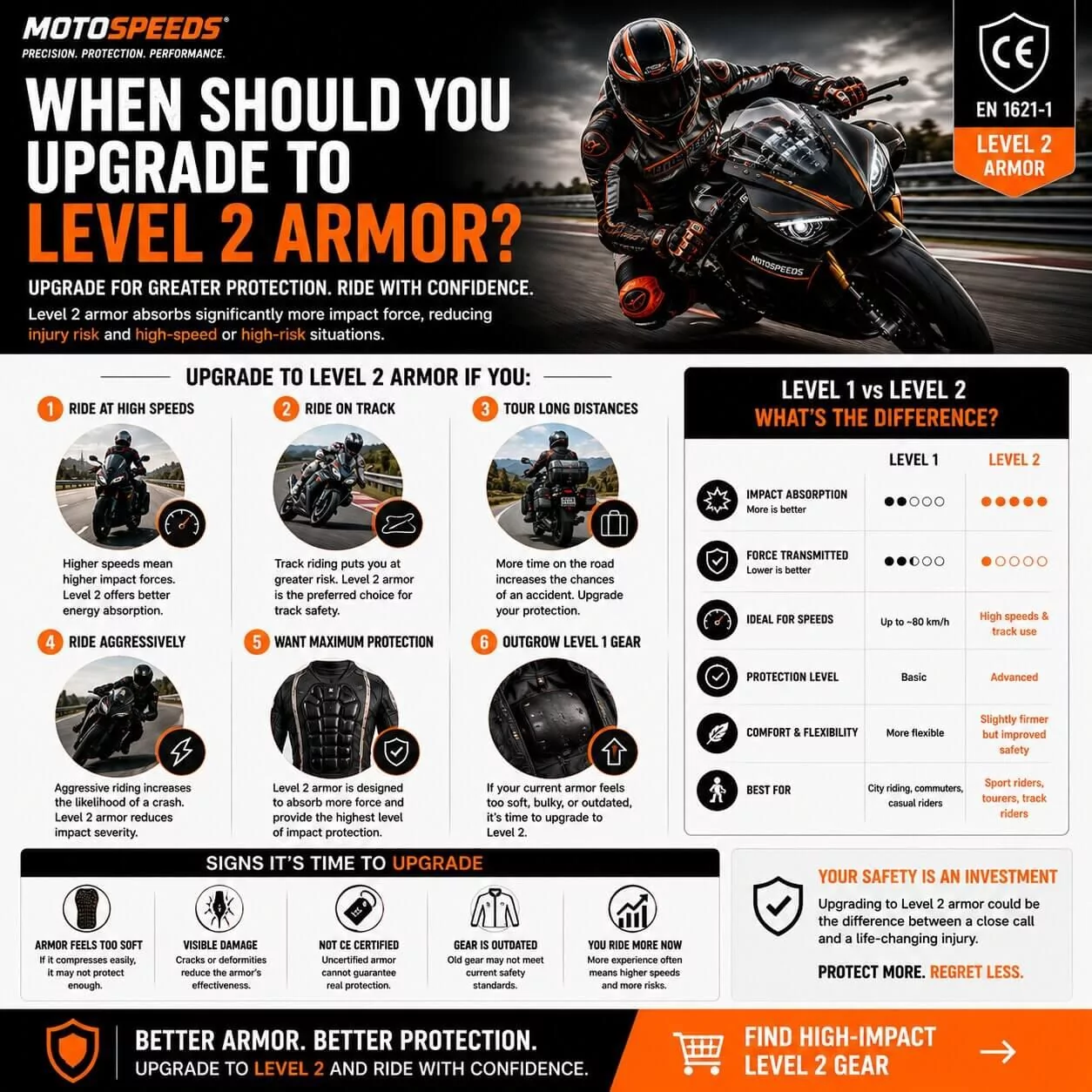
When Should You Upgrade to Level 2 Armor?
You should consider upgrading to CE Level 2 armor if any of these apply to you:
You ride track days regularly or plan to start. Track riding means controlled high-speed riding with more crash risk than street riding. Level 2 armor is the smart choice here. You ride a sportbike or middleweight performance bike at highway speeds regularly. These bikes encourage faster speeds and more aggressive lean angles. Your riding speed is increasing as your skills improve. Beginner riders often start on small bikes with Level 1 armor. When you move to bigger bikes and push speed limits, armor protection should increase too. You've had a crash or close call where you slid hard or impacted something. Once you experience real crash force, you understand armor value. Level 2 armor gives you more confidence and better protection if it happens again. You do long rides where fatigue increases crash risk. Tired riders make mistakes. Better armor is insurance against fatigue-related incidents.
You should stay with Level 1 armor if you're a beginner rider on smaller bikes, ride mostly short trips in familiar areas, prefer comfort for long casual rides, and don't plan to ride at high speeds or on track days. Level 1 is a legitimate choice for your riding style. The best armor is the armor you'll actually wear. If Level 2 armor feels so restrictive that you wear less protective gear instead, you've made a worse safety choice.
Common Mistakes Riders Make When Choosing Armor
Mistake 1: Choosing comfort over crash risk. Riders often pick lighter armor because it feels better during long rides. But you don't feel armor during crashes—you feel the benefits. Judge armor by crash scenario, not comfort preference.
Mistake 2: Assuming all CE Level 2 armor is equal. Different manufacturers engineer armor differently. Some Level 2 armor designs are stiffer and less flexible. Others use better materials that balance protection and comfort better. Test the fit before buying. Real fit differences matter.
Mistake 3: Buying armor based on speed alone. A rider doing 30 mph track laps doesn't need the same armor as a rider doing 70 mph highway crashes. But they might. A track-day rider at 30 mph might crash multiple times a day. That repeated impact risk argues for Level 2. A highway rider at 70 mph might crash once in their lifetime. That single high-speed impact also argues for Level 2. The decision involves both speed and frequency.
Mistake 4: Ignoring abrasion resistance when focusing on impact protection. Armor absorbs impacts. Leather and stitching prevent abrasion. A suit with great armor but thin leather will shred in a long slide. Buy armor and leather as a package, not separately.
Mistake 5: Not replacing armor after a crash. CE armor compresses and absorbs energy. Once it's been hit hard, its structural integrity changes. Damaged armor should be replaced, not reused. Visually inspecting armor is hard because compression damage isn't always obvious from the outside.
Mistake 6: Buying armor you won't wear. An uncomfortable suit stays in the closet. No armor at all is worse than Level 1 armor that you actually wear. Make sure any new gear fits your body, your climate, and your riding schedule.
Final Buying Advice from MotoSpeeds
Choosing between CE Level 1 and Level 2 armor comes down to honest assessment of your crash risk. Be honest about your riding speed, riding environment, skill level, and plans. Don't downgrade protection because you want to feel cool or comfortable. Don't upgrade armor you'll never wear because it feels restrictive.
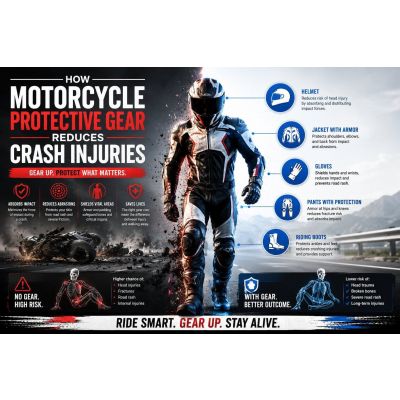
Your protective gear should fit your body first. Armor protects best when it stays positioned correctly on your joints. Proper fit is not optional. Second, your armor should match your riding risk. Street riders at moderate speeds have different needs than track riders or sportbike riders. Third, your armor should cover the right zones. Shoulders, elbows, knees, hips, and back need protection. Don't buy suits with armor only on the elbows if you need hip and knee protection too.
When you're ready to upgrade your protective gear or start fresh with better armor, look for brands that combine quality leather, proper armor placement, and honest safety information. For riders comparing protective gear options and learning about armor performance, MotoSpeeds protective gear is engineered around track-tested safety standards and real rider feedback.
Remember: gear doesn't make you invincible. It reduces injury severity when crashes happen. The best safety strategy is always crash avoidance through skilled riding, smart speed choices, and constant situational awareness. But when crashes do happen—and they happen to good riders—your armor choice determines whether you walk away sore or badly injured.
Frequently Asked Questions About CE Armor Levels
What exactly does CE certification mean for motorcycle armor?
CE certification means the armor has been independently tested under a standardized test protocol by a third-party lab. The test uses a mechanical hammer that drops a weighted head-shaped tool onto the armor from a specific height. The test measures how much impact force the armor absorbs and how much force reaches the material underneath. If the armor meets the test threshold for energy absorption, it receives CE certification. Level 1 and Level 2 have different test speeds and energy thresholds. CE certification doesn't mean armor is perfect—it means it meets minimum tested performance standards.
Can I use Level 1 armor for track days safely?
Level 1 armor provides some protection at track speeds, but it's not optimized for track riding. Track days involve extended time at higher speeds and increased crash probability. You might crash multiple times in a single day. Level 1 armor is tested up to 5.5 meters per second. Track riding often exceeds this. If you do track days regularly, Level 2 armor is the better choice. If you're new to track days and riding cautiously at low speeds, Level 1 is workable short-term. But plan to upgrade as your speed and experience increase.
Does Level 2 armor prevent broken bones?
No. Level 2 armor reduces the force your bones experience during impact, which reduces injury severity. A broken bone at 40 mph might become a severe bruise at 20 mph with good armor. But at high enough impact speeds or with severe enough crashes, broken bones can still occur. Armor is damage reduction, not damage elimination. It's one part of staying safe, along with good riding skills, proper speed management, and crash avoidance.
Is thicker armor always better than thinner armor?
Thicker armor provides more impact absorption potential, but comfort and fit matter too. Very thick armor might restrict movement so much that you don't wear the suit regularly. A suit you wear regularly with adequate protection is better than a suit you wear rarely with maximum protection. Also, thicker armor doesn't guarantee better performance if it doesn't fit your body well or doesn't stay positioned correctly during a crash. The best armor is armor that fits well, stays in place, and you'll actually wear.
Should I replace armor after a crash even if it looks fine?
Yes, you should seriously consider replacing armor after any hard impact crash. Armor works by compressing and absorbing energy. After compression, its structural integrity changes. Damaged armor may not protect as effectively in a second crash. Visual inspection is unreliable because internal material damage isn't always obvious from the outside. The cost of replacement armor is worth the safety benefit. If you're unsure, have the gear inspected by a professional or replace it anyway. Your safety is worth the cost.
What if Level 1 armor fits great but Level 2 armor fits poorly on my body?
Fit is critical to protection. If Level 2 armor shifts around or feels so restrictive that armor position changes when you ride, poor-fitting Level 2 armor might protect worse than well-fitting Level 1 armor. A suit that fits is the best suit. Look for custom-fit options or brands that offer multiple sizing options. Work with brands that prioritize fit as part of safety. The right size suit with good armor placement beats a tight or loose suit with better armor material.
Is there a difference between CE armor from different brands?
Yes. While all CE Level 2 armor meets the same test standard, different manufacturers engineer armor from different materials and densities. Some armor is stiffer and offers excellent protection but less flexibility. Other armor uses newer materials that balance protection and comfort better. Some brands use firmer padding that recovers faster after impact. Performance differences exist even within the same CE level. Test fit and comfort across brands. Don't assume all Level 2 armor feels the same or performs the same way.
Conclusion
The choice between CE Level 1 and Level 2 armor depends on your riding style, crash risk, and honest assessment of your speed and skill level. CE Level 1 vs. Level 2 armor isn't about one being universally better—it's about matching protection to your actual riding. Street riders doing moderate-speed commuting often find Level 1 armor adequate. Track riders, sportbike riders, and high-speed riders should prioritize Level 2 armor and the protection it provides.
Remember that armor quality is just one part of gear protection. Leather thickness, stitching quality, abrasion resistance, armor placement, and fit all work together to protect you in a crash. Even the best armor can't prevent all injuries, but it dramatically reduces injury severity when crashes happen. Your next step is honestly evaluating your riding risk, finding gear that fits your body well, and prioritizing protection over short-term comfort.
When you're ready to buy new protective motorcycle gear engineered for impact protection and real-world riding, explore MotoSpeeds performance-driven protective gear designed for riders serious about safety, fit, and performance.