Table of Contents
Introduction
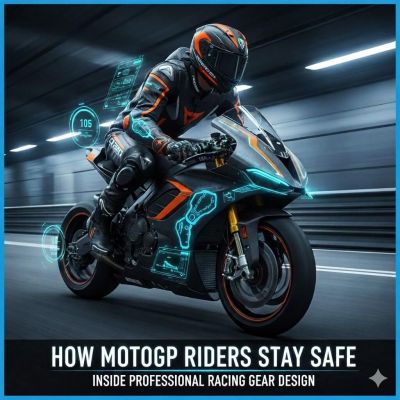
MotoGP is the highest level of motorcycle racing on the planet — where riders routinely exceed 350 km/h, lean at over 60 degrees, and experience brutal crashes that would be life-ending without professional gear. Behind every rider is a complex safety system built from racing suits, CE-certified armor, airbags, boots, gloves, and countless micro-engineering details designed to protect the body at extreme speed.
In this guide, we dive deep into , explain MotoGP safety, break down the aerodynamic hump, map impact zones, and uncover the hidden safety design principles that keep elite riders alive on the world’s fastest tracks.
If you’re passionate about racing or want to upgrade your protection, this article gives you an inside look into the same technology powering today’s MotoGP champions.
What Makes Professional Motorcycle Racing Gear Different?
Professional race gear isn’t just “better quality leather.”
It’s strategically engineered for protection, aerodynamics, and survival in high-speed crashes.
Here’s what separates pro-grade MotoGP suits from basic riding jackets:
1. Superior impact absorption (CE Level-2 armor)
2. Race-grade kangaroo or cowhide leather
3. Airbag-ready interior design
4. Aerodynamic hump for stability and airflow
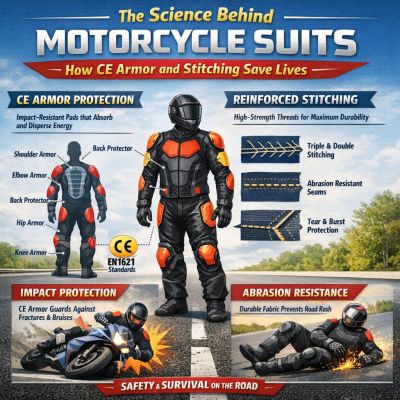
5. Reinforced stitching (Triple & Quadruple)
6. Sliders engineered to take abrasion, not tear
7. Pre-curved ergonomics for race posture
Every inch of the suit works together to maximize protection in the milliseconds during a crash.
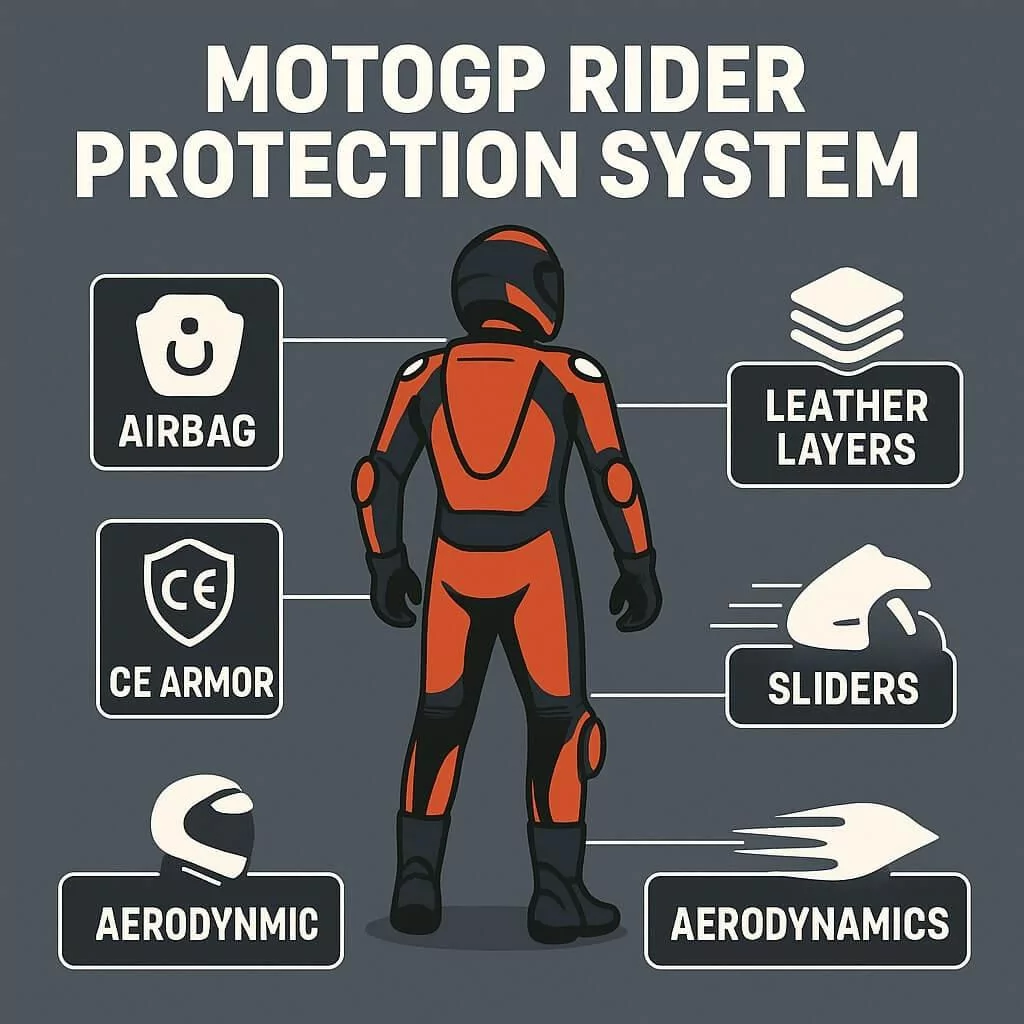
The Science of MotoGP Safety
MotoGP crash data shows riders experience:
Up to 25G forces during high-side landings
Abrasion at 200–300 km/h
Multiple rollovers in a single crash
Slide distances exceeding 70 meters
Impact Energy & Crash Physics
When a rider crashes, two main forces occur:
1. Impact Force
The initial “hit” when the rider contacts the ground — typically absorbed by armor.
2. Abrasion
The slide across tarmac, which can instantly burn through regular clothing.
Professional racing gear is built to handle both simultaneously.
Understanding the MotoGP Leather Suit
Premium Leather Construction
MotoGP suits use:
Kangaroo leather (lightweight, extremely strong)
1.2–1.4mm cowhide reinforced in high-impact areas
Double & triple layers at slide zones
Heat-resistant Kevlar stretch panels
A racing suit functions like a second skin — tight, supportive, and protective.
The Aerodynamic Hump: What It Really Does
A common question riders ask is:
“Does the hump protect your spine?”
Yes — but that’s only one part of its job.
✔ 1. Aerodynamics
The hump smooths airflow from helmet to back, reducing turbulence.
✔ 2. Safety & Impact Absorption
It acts as a protective buffer for the upper spine and neck area.
✔ 3. Airbag Integration
Modern MotoGP suits house internal airbag components inside the hump.
✔ 4. Hydration Systems
Many riders use the hump to store hydration bladders for long races.
It's a multifunctional component engineered for speed + safety.
Flex Zones & Mobility Panels
MotoGP suits must be protective and flexible.
These include:
Accordion stretch leather
Aramid/Kevlar stretch zones
Underarm mobility panels
Inner thigh and back stretch fabric
Flex zones allow riders to maintain race posture comfortably and prevent tearing during falls.
Internal Lining, Ventilation & Heat Control
Pro riders lose up to 3 liters of sweat in a race.
Gear must remain breathable and comfortable.
Features include:
Antibacterial inner mesh
Perforated leather cooling
Moisture-wicking liners
Air channels built into the chest and arms
Comfort is also part of safety — fatigue = slower reaction time.
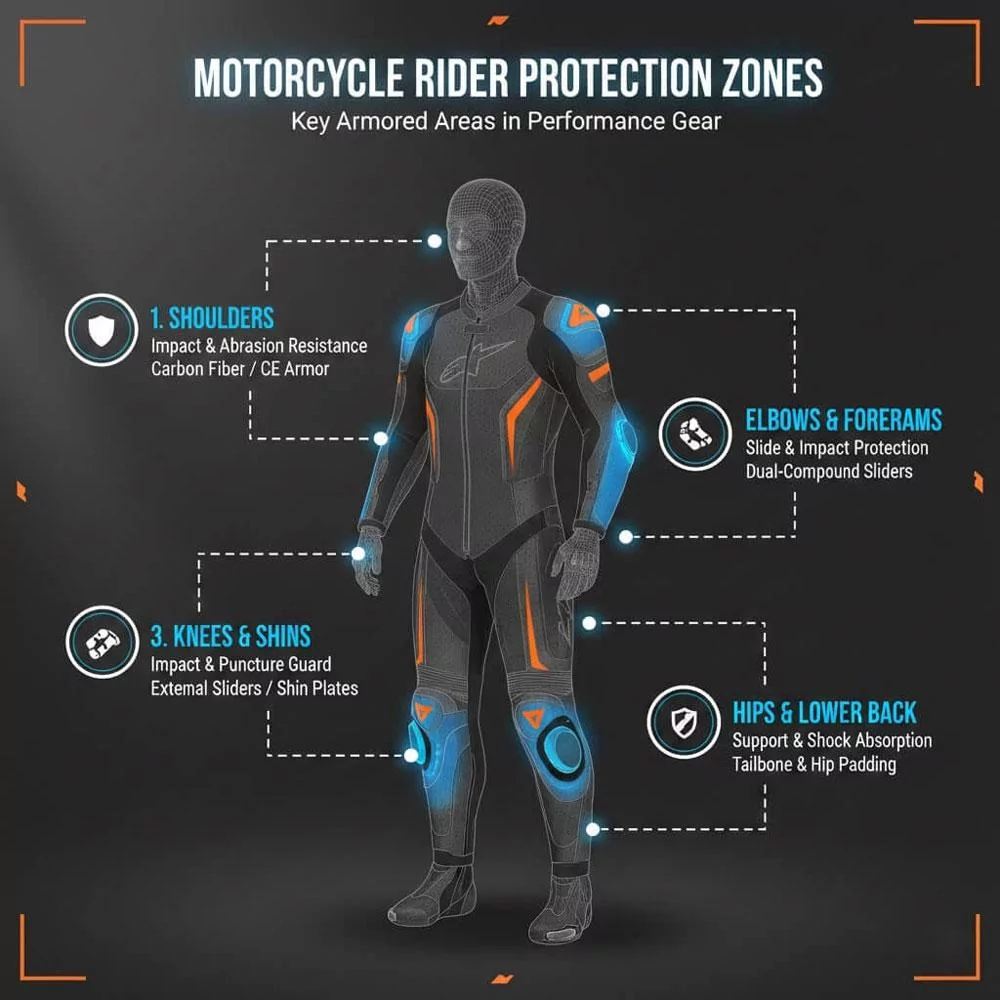
Critical Impact Zones in MotoGP Gear
Different parts of the body absorb different crash forces.
Professional motorcycle racing gear is reinforced based on injury statistics.
1. Shoulders
Hard TPU protectors
Memory foam underlay
External titanium or carbon sliders
Designed to prevent clavicle fractures and control slide direction.
2. Elbows & Forearms
External elbow sliders (MotoGP style)
CE-rated forearm armor
Abrasion-resistant double layering
Protects bones that commonly break during lowsides.
3. Knees & Shins
Knee sliders for lean angle contact
CE-2 shin armor
Double-stitched curved leather
Critical for both protection and riding technique.
4. Hips & Lower Back
Hip armor + foam padding
Reinforced lower back panel
Stretch zones for rider mobility
One of the most injury-prone areas during high-sides.
Gloves, Boots & Additional Protection
MotoGP Gloves
External finger sliders
Kevlar lining
Hard knuckle protectors
Palm sliders to prevent wrist fractures
MotoGP Boots
Boots are designed to protect:
Ankles
Achilles tendon
Toes
Tibia & shin
They typically include:
Hinged ankle braces
Reinforced toe sliders
Anti-twist sole construction
Armor layered under micro-fiber and leather
Airbag Technology: MotoGP’s Biggest Safety Revolution
Modern MotoGP suits include electronic airbag systems with:
6–12 sensors
gyroscopes
accelerometers
AI crash prediction algorithms
The system inflates in 20–40 milliseconds to protect:
Neck
Shoulders
Chest
Collarbone
Ribs
This innovation alone has reduced collarbone injuries by over 90%.
How MotoGP Gear Is Designed & Tested
Professional gear undergoes:
✔ Wind tunnel testing
✔ High-speed abrasion tests
✔ Triple-stitch tear resistance checks
✔ Airbag deployment trials
✔ Ergonomic fit evaluation
✔ Track testing with professional riders
MotoGP suits represent the highest standard of protective engineering in motorsports.
Why Amateur Riders Should Learn From MotoGP Gear
You don’t need to ride at 300 km/h to benefit from professional-grade gear.
Amateur riders gain:
Better crash protection
Improved confidence
More agile movement
Reduced fatigue
Enhanced cornering comfort
Safer trackday performance
Upgrading to pro-style leather suits is an investment in safety, not luxury.
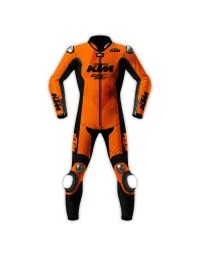
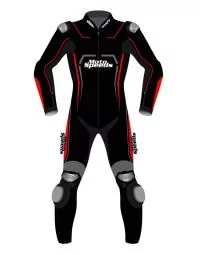
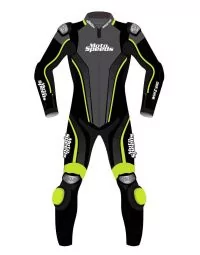
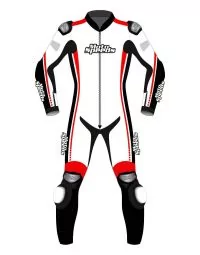
For example, you can explore a race-ready option like the
KTM RC 390 Motorcycle Leath
er Race Suit
And for more elite options, browse our full racing gear collection.
Conclusion
Every MotoGP rider is equipped with a full ecosystem of protection — from high-quality leather suits to airbags, armor, aerodynamic humps, and biomechanical safety systems. Professional motorcycle racing gear is the result of decades of engineering evolution, designed to keep riders alive in the world’s fastest, most dangerous motorsport.
Whether you're an everyday rider or a trackday enthusiast, understanding this technology helps you make smarter choices — because real protection starts long before you hit the throttle.
FAQs (Schema-Ready)
Q1: Why is professional motorcycle racing gear so important?
Because MotoGP riders face extreme speeds, G-forces, and high-risk crashes. Professional gear absorbs impact, prevents abrasion injuries, stabilizes the body, and reduces serious trauma.
Q2: What does the aerodynamic hump do?
It improves airflow, protects the spine, integrates airbag systems, and may house hydration packs.
Q3: Do MotoGP suits include airbags?
Yes. Modern suits use electronic airbags that deploy in milliseconds to protect the upper body.
Q4: What leather is used in MotoGP suits?
Kangaroo leather and premium-grade cowhide reinforced with Kevlar stretch materials.
Q5: Is MotoGP gear useful for regular riders?
Absolutely — the protection benefits apply to trackday riders and street riders looking for better safety.