Table of Contents
- Introduction
- Why Safety Certifications Matter
- CE Approved Standards: European Excellence
- SFI Standards: American Racing Heritage
- FIA Standards: Formula Racing Precision
- Class AA (Touring Standard): Long-Distance Protection
- Comparative Analysis: Which Standard Fits Your Needs?
- How to Verify Authentic Certifications
- The Future of Protective Standards
- FAQs
- Conclusion
Introduction
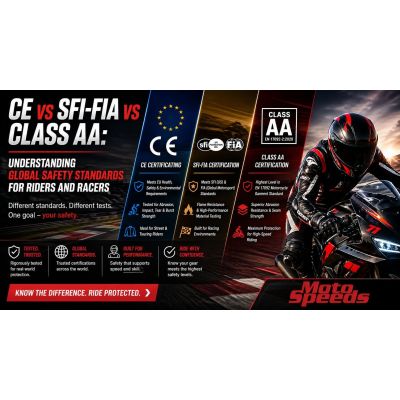
When you're traveling at triple-digit speeds or navigating challenging terrain, the difference between quality protective gear and substandard equipment can be life-changing. Yet, walking into any motorcycle shop or browsing online retailers reveals a confusing alphabet soup of safety certifications: CE, SFI, FIA, Class AA, and more. What do these acronyms actually mean, and more importantly, which ones should you trust with your safety?
Understanding gear safety certifications isn't just about ticking regulatory boxes—it's about making informed decisions that could save your life. Whether you're a track-day enthusiast, professional racer, adventure tourer, or daily commuter, knowing the distinctions between international protective standards empowers you to choose equipment that matches your specific riding style and risk profile.
This comprehensive guide breaks down the four major safety certification systems that dominate the global market for motorcycle and racing protective gear. We'll explore what each standard tests for, who governs them, where they're recognized, and most critically, which situations demand which level of protection.
Why Safety Certifications Matter
The Real-World Impact of Standards
Safety certifications exist because accidents don't discriminate. A 2023 study by the European Association of Motorcycle Manufacturers found that riders wearing certified protective gear experienced 47% fewer severe injuries compared to those in uncertified equipment during comparable crashes. These aren't arbitrary numbers printed on tags—they represent rigorous testing protocols that simulate real-world impact scenarios.
Beyond Marketing: Understanding Test Protocols
Manufacturers can claim anything, but certification bodies provide independent verification. When a jacket carries a genuine CE marking or an FIA homologation tag, it means third-party laboratories have subjected that gear to specific impact tests, abrasion resistance evaluations, seam strength assessments, and sometimes even flame resistance trials. The tests vary significantly between standards, which is why understanding these differences matters.
Legal and Insurance Implications
In many regions, wearing certified protective gear isn't just recommended—it's legally mandated. European Union regulations require CE-certified equipment for professional racing and increasingly for street riding. Some insurance policies explicitly require certified gear for coverage validation. Understanding which certifications apply in your jurisdiction protects not just your body but your legal and financial standing.
CE Approved Standards: European Excellence
What is CE Certification?
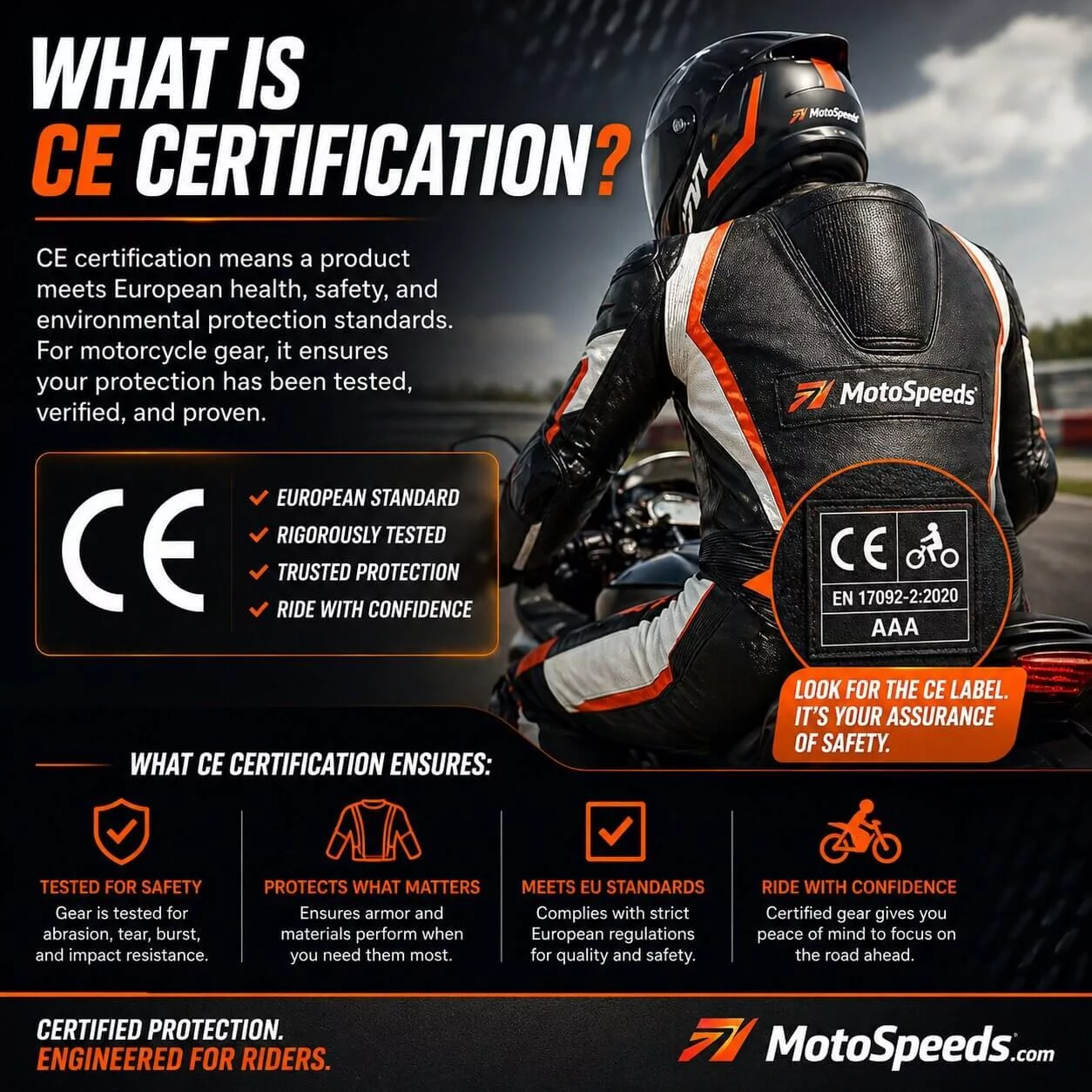
CE (Conformité Européenne) marking indicates that protective equipment complies with European Union safety, health, and environmental protection standards. For motorcycle gear, this specifically refers to Regulation (EU) 2016/425 on Personal Protective Equipment (PPE). The CE system isn't a single standard but a framework of specific requirements for different gear categories.
CE Levels Explained
CE Level 1
The baseline certification represents minimum protection requirements. Level 1 armor absorbs and dissipates impact energy below specified thresholds during standardized drop tests. While suitable for casual street riding and lower-speed applications, Level 1 offers less protection than higher tiers.
Typical applications: Urban commuting jackets, textile riding jeans, summer gloves
Impact energy limits: ≤35 kN for limb protectors, ≤50 kN for back protectors
CE Level 2
Enhanced protection with significantly stricter impact absorption requirements. Level 2 armor reduces transmitted force by approximately 40% more than Level 1, making it the preferred choice for spirited riding, touring, and track days.
Typical applications: Sport-touring suits, adventure gear, race-replica jackets
Impact energy limits: ≤20 kN for limb protectors, ≤18 kN for back protectors
CE AAA (Highest Abrasion Rating)
Beyond impact protection, CE also rates abrasion resistance. The AAA rating represents the highest level, requiring materials to withstand significant sliding friction without tearing through—critical during crashes where sliding is inevitable.
Material requirements:
- 4+ seconds abrasion resistance at 75 mph (120 km/h)
- Typically requires leather, aramid fibers, or high-grade technical textiles
- Common in professional racing suits and premium sport jackets
CE Marking: What to Look For
Genuine CE certification includes several identifiable elements:
- The "CE" mark itself
- Four-digit number identifying the notified body (e.g., CE 0494)
- Reference to EN standard (e.g., EN 1621-1:2012 for impact protection)
- Level designation (Level 1, Level 2, or AAA for abrasion)
Geographic Recognition
CE standards dominate European, Middle Eastern, and increasingly Asian markets. While not legally required in North America or Australia, many international manufacturers design to CE standards for global market access, making CE-certified gear widely available worldwide.
SFI Standards: American Racing Heritage
The SFI Foundation's Mission
Founded in 1978, the SFI Foundation (formerly Sports Car Club of America Foundation Inc.) develops and administers voluntary performance and safety specifications for racing equipment. Unlike government-mandated regulations, SFI standards are industry-driven, creating benchmarks that often exceed basic safety requirements.
Key SFI Specifications for Riders
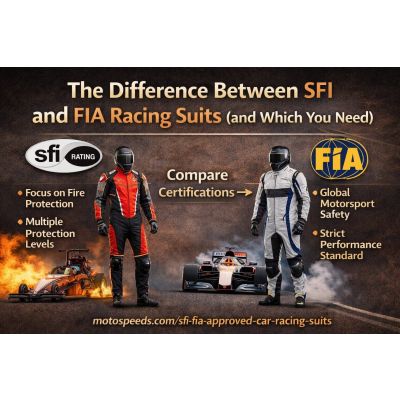
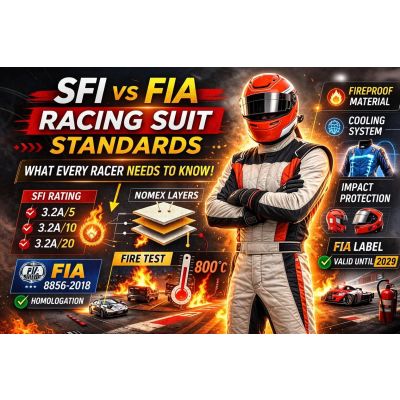
SFI 3.2A/1 - Racing Suits (Single Layer)
Entry-level racing suit specification requiring single-layer construction with minimum flame resistance. Popular in club racing and track days where extreme fire protection isn't mandated.
Protection focus:
- 3-second minimum flame exposure protection
- Tensile strength requirements for seams
- Required in many amateur motorcycle road racing series
SFI 3.2A/5 - Racing Suits (Multi-Layer)
Professional-grade specification requiring multi-layer construction for enhanced thermal protection. The "/5" designation indicates five layers of flame-resistant material—standard for professional motorcycle racing and high-performance track use.
Protection focus:
- 10+ second flame exposure protection
- Multiple material layers for thermal insulation
- Significantly higher abrasion resistance
- Required in MotoAmerica, AMA Pro Racing, and similar series
SFI 3.3 - Gloves
Dedicated specification for racing gloves covering flame resistance, grip integrity, and structural protection. These gloves must maintain performance after repeated impact and thermal exposure.
SFI 41.1 - Boots
Racing boot specification addressing ankle support, sole grip, shift pad durability, and flame resistance. Critical for riders who need consistent foot placement during aggressive riding.
SFI Recertification Requirements
Unlike some certifications that remain valid indefinitely, SFI specifications require periodic recertification. Racing suits, for instance, carry expiration dates—typically two years from manufacture for single-layer and five years for multi-layer suits. This ensures materials haven't degraded and that gear meets current standards as they evolve.
Where SFI Dominates
SFI standards are predominantly recognized in North American racing circuits, including:
- AMA Pro Racing (Superbike, Supersport, MotoAmerica)
- CCS (Championship Cup Series)
- WERA (Western Eastern Roadracing Association)
- Many track day organizations in the United States and Canada
While less common outside North America, SFI-certified gear is accepted at international events when FIA certification isn't specifically mandated.
FIA Standards: Formula Racing Precision
The Fédération Internationale de l'Automobile
The FIA governs international motorsport, setting safety standards that represent the absolute pinnacle of protective equipment testing. While primarily associated with four-wheel racing (Formula 1, WRC, WEC), FIA standards increasingly influence motorcycle racing at the highest levels.
FIA Homologation Numbers Decoded
FIA certifications use homologation numbers that indicate standard type and validity period:
Format Example: FIA 8856-2018
- 8856 = Standard type (racing suit specification)
- 2018 = Year standard was issued
FIA 8856-2018 - Racing Suits (Current)
The gold standard for racing suits, requiring extensive testing including:
- Flame propagation resistance (11+ seconds minimum protection)
- Heat transfer protection (maintains skin temperature below critical thresholds)
- Abrasion resistance across multiple zones
- Seam strength under extreme forces
- Compatibility with HANS devices and safety systems
This standard replaced FIA 8856-2000 and represents decades of crash data analysis and material science advancement.
FIA 8877-2022 - Underwear and Base Layers
Often overlooked, FIA-certified base layers provide critical secondary protection, especially in fire scenarios where seconds matter. These garments use advanced flame-resistant materials like Nomex or PBI that don't melt or drip when exposed to flames.
FIA 8856-2000 - Previous Generation (Still Valid)
The predecessor standard remains valid for several more years but offers less protection than the 2018 revision. Many privateer racers still use 8856-2000 certified gear, which satisfies minimum requirements for most racing series.
The FIA Testing Process
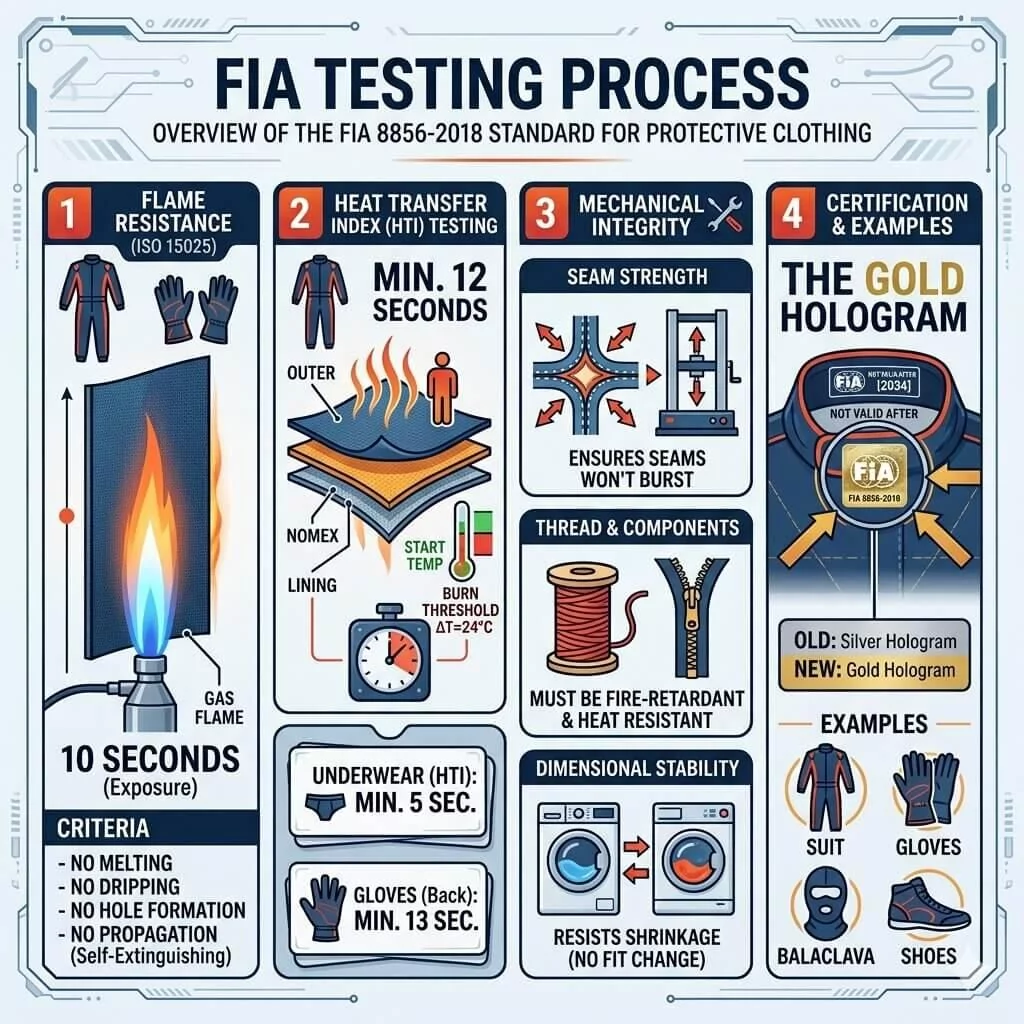
FIA homologation is extraordinarily rigorous. To earn certification, manufacturers must submit production samples (not prototypes) to FIA-approved laboratories. Testing includes:
- Thermal Protection Tests: Exposing suits to direct flame for specified durations while monitoring heat transfer through the material
- Impact Abrasion: Simulating sliding contact with track surfaces at racing speeds
- Tear Propagation: Ensuring seams and materials don't catastrophically fail under stress
- Dimensional Stability: Verifying gear maintains protective properties after washing and normal use
Failed tests require complete redesign and resubmission. This strict protocol ensures FIA certification represents verified, repeatable protection.
Even where not mandatory, FIA-certified gear represents the choice of professional racers worldwide who trust nothing less than the highest verified protection.
Class AA (Touring Standard): Long-Distance Protection
Understanding the Touring Classification
Class AA represents the European touring standard—a specialized CE classification designed specifically for riders who spend extended periods in the saddle, often in varied weather conditions and across long distances. This certification bridges the gap between daily commuter gear and full racing equipment.
What Makes Class AA Unique
Unlike track-focused standards that optimize for maximum impact at racing speeds, Class AA balances protection with comfort, weather resistance, and durability over thousands of miles. The specification recognizes that adventure riders and touring enthusiasts face different risk profiles than circuit racers.
Protection Standards
- Impact protection: CE Level 1 or Level 2 armor at shoulders, elbows, back, knees, and hips
- Abrasion resistance: Minimum Class A rating (AA or AAA in critical zones)
- Seam strength: Enhanced stitching requirements for long-term durability
- Weather protection: Integrated or compatible waterproof/breathable membranes
Comfort and Usability Features
Class AA certification often includes requirements for:
- Ventilation systems for hot-weather riding
- Thermal liner compatibility for cold conditions
- Ergonomic armor placement that doesn't create pressure points during long rides
- Reflective elements for visibility in varied lighting
Typical Class AA Applications
Adventure Touring Suits: Multi-season gear designed for riders crossing continents, encountering everything from desert heat to mountain rain. Class AA certification ensures these suits protect during unexpected offs while maintaining comfort during 500+ mile days.
Sport-Touring Jackets and Pants: Equipment for spirited riders who prioritize versatility. These garments perform on winding canyon roads and during highway slogs, offering protection that doesn't compromise all-day wearability.
Long-Distance Commuter Gear: Urban riders who rack up serious mileage benefit from Class AA's durability standards. The certification ensures gear withstands daily use without protection degradation.
Class AA vs Pure Racing Standards
The key philosophical difference: Class AA optimizes for the marathon, not the sprint. Racing standards like FIA 8856-2018 prioritize maximum protection for controlled environments (closed circuits with medical support). Class AA prioritizes sustainable protection for uncontrolled environments (public roads, remote areas, varied conditions) where riders need gear that performs consistently across thousands of miles and multiple years.
Comparative Analysis: Which Standard Fits Your Needs?
Head-to-Head Comparison
| Feature | CE (Level 2/AAA) | SFI 3.2A/5 | FIA 8856-2018 | Class AA |
|---|---|---|---|---|
| Primary Focus | Impact + Abrasion | Flame Resistance + Impact | Complete Racing Protection | All-Weather Touring |
| Impact Protection | Excellent (≤20 kN) | Good | Excellent + Thermal | Good to Excellent |
| Abrasion Resistance | Outstanding (AAA rated) | Very Good | Outstanding | Good (Class A minimum) |
| Flame Resistance | Not typically tested | Required (10+ seconds) | Required (11+ seconds) | Not required |
| Geographic Recognition | Europe, Global | North America | Worldwide (Racing) | Europe, Global Touring |
| Recertification | None (permanent) | 2-5 years | Valid to standard expiry | None (permanent) |
| Best For | Street/Track Versatility | American Circuit Racing | International Racing | Adventure/Touring |
Scenario-Based Recommendations
Track Day Enthusiast (Non-Professional)
Recommended: CE Level 2 with AAA abrasion rating or SFI 3.2A/1 minimum Why: Most track day organizations accept either standard. CE Level 2 offers excellent impact protection without the recertification costs of SFI. If your local circuit specifically requires SFI, the 3.2A/1 spec provides adequate protection at reasonable cost.
Professional Road Racer
Recommended: FIA 8856-2018 (MotoGP, WorldSBK) or SFI 3.2A/5 (AMA Pro Racing) Why: Series regulations typically mandate specific standards. FIA represents the global gold standard, while SFI dominates American professional racing. Both offer maximum verified protection for racing conditions.
Adventure Rider / World Traveler
Recommended: Class AA touring certification with CE Level 2 armor Why: Long-distance riders need gear that performs across climates and remains comfortable for 8+ hour days. Class AA's durability standards ensure protection doesn't degrade after thousands of miles. CE Level 2 armor provides superior impact protection for unexpected incidents on remote roads.
Daily Commuter (Urban/Highway)
Recommended: CE Level 1 or Level 2 (depending on speed/traffic) Why: Street-focused protection without racing-specific features you won't use. CE certification ensures verified safety while keeping costs reasonable. Level 2 recommended for high-speed commuting or aggressive riders.
Canyon Carver / Sport Rider
Recommended: CE Level 2 with AAA abrasion rating Why: Spirited street riding demands serious protection. CE Level 2 provides track-grade impact protection, while AAA abrasion rating ensures materials survive the inevitable slide. This combination offers racing protection without racing-specific flame requirements that add cost and weight.
Multi-Standard Gear: The Best of Both Worlds?
Premium manufacturers increasingly design gear meeting multiple certifications simultaneously. A high-end racing suit might carry both FIA 8856-2018 and CE AAA ratings, or sport-touring gear might feature Class AA certification with CE Level 2 armor. These multi-certified products offer maximum versatility, allowing riders to use the same equipment across different riding contexts.
Advantages:
- One investment covers multiple use cases
- Simplified gear management for riders who track and tour
- Maximum verified protection across scenarios
Considerations:
- Higher initial cost (typically 20-40% premium)
- May include features you don't need for your primary riding style
- Heavier/bulkier than single-purpose gear
FAQs
What's the difference between CE Level 1 and Level 2 armor?
CE Level 2 armor reduces transmitted impact force by approximately 40% more than Level 1. Specifically, Level 2 limb protectors transmit maximum 20 kN force versus 35 kN for Level 1. For riders who push limits or frequently ride at higher speeds, Level 2 provides significantly better protection with minimal weight or comfort penalty.
Can I wear SFI-certified gear for street riding?
Absolutely. SFI gear provides excellent protection for street use, though it's engineered primarily for racing conditions. The main consideration is that SFI specifications emphasize flame resistance, which adds cost and sometimes reduces breathability compared to street-focused gear. SFI suits also have expiration dates requiring periodic replacement.
Do I need FIA-certified gear for track days?
Not typically. Most track day organizations accept CE Level 2 or SFI 3.2A/1 as minimum requirements. FIA certification is generally required only for professional racing series and high-level amateur competitions. However, FIA gear provides the highest verified protection if budget permits.
How long does gear certification last?
CE and Class AA certifications don't expire—the gear remains certified throughout its usable life (though materials degrade over time). SFI certifications expire after 2-5 years depending on specification. FIA homologations typically remain valid for 10 years from the standard's release date. Always check labels for specific expiration information.
Is more expensive gear always safer?
Not necessarily. Price reflects materials, construction quality, brand positioning, and features beyond pure safety. A $300 jacket with genuine CE Level 2 and AAA certification provides verified protection comparable to a $1,200 jacket with identical certifications. However, premium gear often offers better fit, durability, comfort, and additional features. Always verify actual certifications rather than assuming price equals protection.
Can I upgrade armor in my existing jacket?
Many jackets feature removable armor pockets allowing upgrades. You can typically replace Level 1 armor with Level 2 inserts if pocket dimensions match. However, upgrading doesn't change the garment's overall certification—if your jacket is certified only for Level 1, installing Level 2 armor doesn't make it a "Level 2 jacket" (the textile abrasion rating and construction remain unchanged). Still, upgrading armor improves impact protection in those specific zones.
What certification do I need for international riding?
For touring across multiple countries, CE-certified gear with Class AA touring designation provides the broadest acceptance. If your route includes countries with specific requirements (some require CE specifically), research those regulations beforehand. For general international touring, CE Level 2 with AAA abrasion rating covers most scenarios.
Are there certifications specifically for women's gear?
Certification standards apply universally regardless of intended wearer. The testing protocols don't change for women's versus men's gear. However, properly fitted gear (regardless of gender labeling) provides better protection since armor must align correctly with impact zones. Choose gear that fits your body properly rather than focusing on gender-specific marketing.
Conclusion
Navigating the landscape of gear safety certifications—CE, SFI, FIA, and Class AA—empowers you to make informed decisions that literally save lives. Each standard serves distinct purposes: CE provides versatile street and track protection with clear level designations; SFI dominates North American racing with its flame-resistance focus; FIA represents the absolute pinnacle for international racing; and Class AA optimizes for the unique demands of long-distance touring.
The "best" certification isn't universal—it depends on your riding style, geographic location, and specific needs. Track-focused riders benefit from SFI or FIA's racing-specific testing. Street riders and tourers find CE and Class AA certifications better matched to real-world conditions. Many riders maintain multiple gear sets for different contexts, choosing the right tool for each job.
Three critical takeaways:
Verify authenticity: Counterfeit certifications provide zero protection. Always check for proper labels, notified body numbers, and standard references before trusting your safety to any gear.
Match standards to activities: Don't under-protect for racing or over-invest in features you don't need for commuting. Understanding what each standard tests ensures your gear matches your actual risk profile.
Remember that certification is a minimum: Even the highest-rated gear only protects when worn properly and maintained correctly. The best suit in the world provides zero protection hanging in your closet.
As safety standards evolve with new technologies and crash data, staying informed keeps you protected. Bookmark certification body websites, follow industry news, and replace gear as standards advance. Your safety deserves nothing less than genuine, verified protection.
Ready to upgrade your gear with confidence?