Table of Contents
Introduction
Most riders buy gear hoping they will never truly “test” it.
We all picture that one bad day, but secretly hope it never comes.
Then one slide, one impact, or one misjudged corner decides everything.
In that moment, your
suit, jacket, gloves, and boots either do their job.
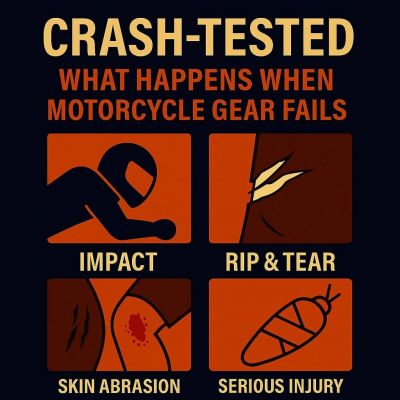
This article looks at what really happens when motorcycle gear fails in a crash.
We’ll walk through how motorcycle crash protection should work, how abrasion tests predict real-world outcomes, and why even leather can fail if design and fit are wrong.
You’ll also read a real accident case study that shows the difference between low-quality gear and proper protection.
I’m not here to scare you.
I’m here to help you make smarter choices before your next ride.
The Illusion of Safety: When Gear Only Looks Strong
Walk into any store and you’ll see jackets with racing stripes, big logos, and “race spec” patches.
Some are real protection.
Some are just fashion with armor-looking foam.
On a hanger, they all look similar.
On the road, they are not.
Real motorcycle crash protection comes from:
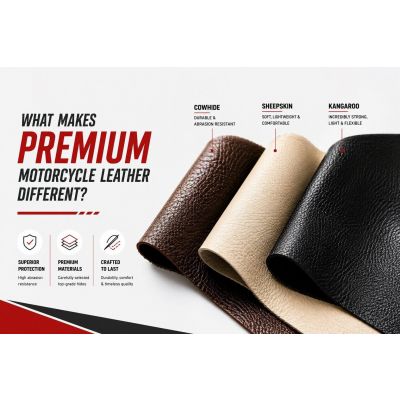
Tested materials
Correct leather thickness
CE-rated armor
Strong seam construction
Smart pattern layout
Fake toughness often means:
Thin panels
Single stitching
Soft, non-certified “armor”
Weak lining
When a crash happens, those hidden details decide whether your gear saves you or your skin pays the price.
How Motorcycle Crash Protection Is Supposed to Work
To understand failure, you must first understand success.
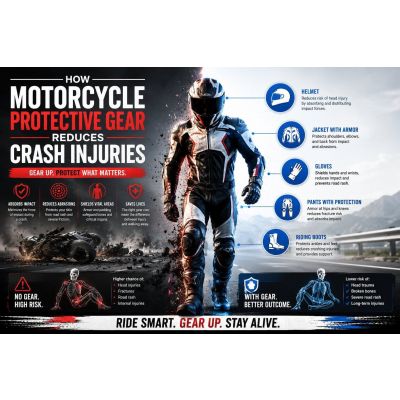
Good motorcycle crash protection works like a three-stage system.
Stage 1: Keep your skin off the road
The outer shell, usually leather, must stay intact long enough that the asphalt never touches your skin.
If the suit bursts open at a seam, that first job is already lost.
Stage 2: Spread and absorb impact
CE armor at the shoulders, elbows, hips, knees, and back spreads impact force over a larger area.
Under that armor, foam and inner layers absorb energy so your bones and joints don’t take it all at once.
Stage 3: Control slide and reduce twisting
Sliders, smooth panels, and a good fit help you slide instead of catch and tumble.
Sliding might look scary, but tumbling often causes broken bones and torn ligaments.
When any of these stages is weak — shell, armor, or design — failure shows up fast in a real crash.
Abrasion Tests: What the Lab Tells Us
Abrasion tests simulate what happens when you slide on the road.
A small sample of leather is pressed onto a spinning abrasive surface.
Testers measure how long it takes for the material to wear through.
The longer it lasts, the better your chances in a slide.
Quality race leather can survive several seconds of abrasion.
Cheap “leather look” materials may fail in under a second.
On the street or track, that difference decides whether you end up with bruises — or deep road rash that needs skin grafts.
But remember:
Abrasion tests assume the material is used correctly.
Even strong leather won’t help if a weak seam tears and exposes thin liner or bare skin.

Leather Failure: Why Good Suits Still Tear
A lot of riders think, “It’s real leather, so I’m safe.”
Sadly, that’s not always true.
Leather failure happens more often at weak connection points than in the middle of panels.
Common failure areas include:
Seat and crotch
Shoulders and upper arms
Around zippers and stretch panels
Why?
Because those areas bend, twist, and stretch hardest during a crash.
If a seam runs right across a high-impact area, the thread, not the leather, becomes the weak link.
That’s why serious race suits use:
Triple stitching
Overlapping panels
Seam placement away from main impact zones
It’s not just “leather or not.”
It’s how that leather is cut, joined, and reinforced.
Real Accident Case Study: Two Riders, One Corner
Let’s look at a simple real-style case that shows all of this in action.
Two friends go to the same track day.
Same group, similar bikes, similar speed.
But very different gear.
Jake’s gear
Jake wears a full leather suit bought online from a discount brand.
It looks sharp and has bold graphics.
The tag says “race quality construction.”
The leather feels thin.
The armor moves around inside the pockets when he walks.
The price was too good to be true.
Leo’s gear
Leo wears a higher-end one-piece race suit from a trusted manufacturer.
It uses thick leather, CE Level 2 armor, and visible triple stitching.
The suit feels snug when he stands, but perfect in a tucked riding position.
Sliders and stretch panels line up right where they should.
The crash
Late in the day, both riders enter a fast right-hand corner.
A dusty patch near the apex breaks traction.
Both Jake and Leo low-side at about 90 km/h and slide across the same run-off zone.
The outcome
Leo slides, tumbles once, and stops.
His suit is heavily scuffed at shoulder, elbow, and hip, but all seams remain closed.
The armor stays in place.
He walks away with strong bruising and sore muscles — but no open wounds.
Jake’s suit tells a different story.
Within the first second of sliding, the outer thigh seam bursts.
The leather flap peels back like a door.
Thin lining and skin grind across the surface.
By the time he stops, Jake has deep abrasion from hip to knee.
He spends days in hospital, then weeks changing dressings.
Same corner.
Same speed.
Same crash type.
Very different motorcycle crash protection.
The difference was not luck.
It was construction quality and suit design.
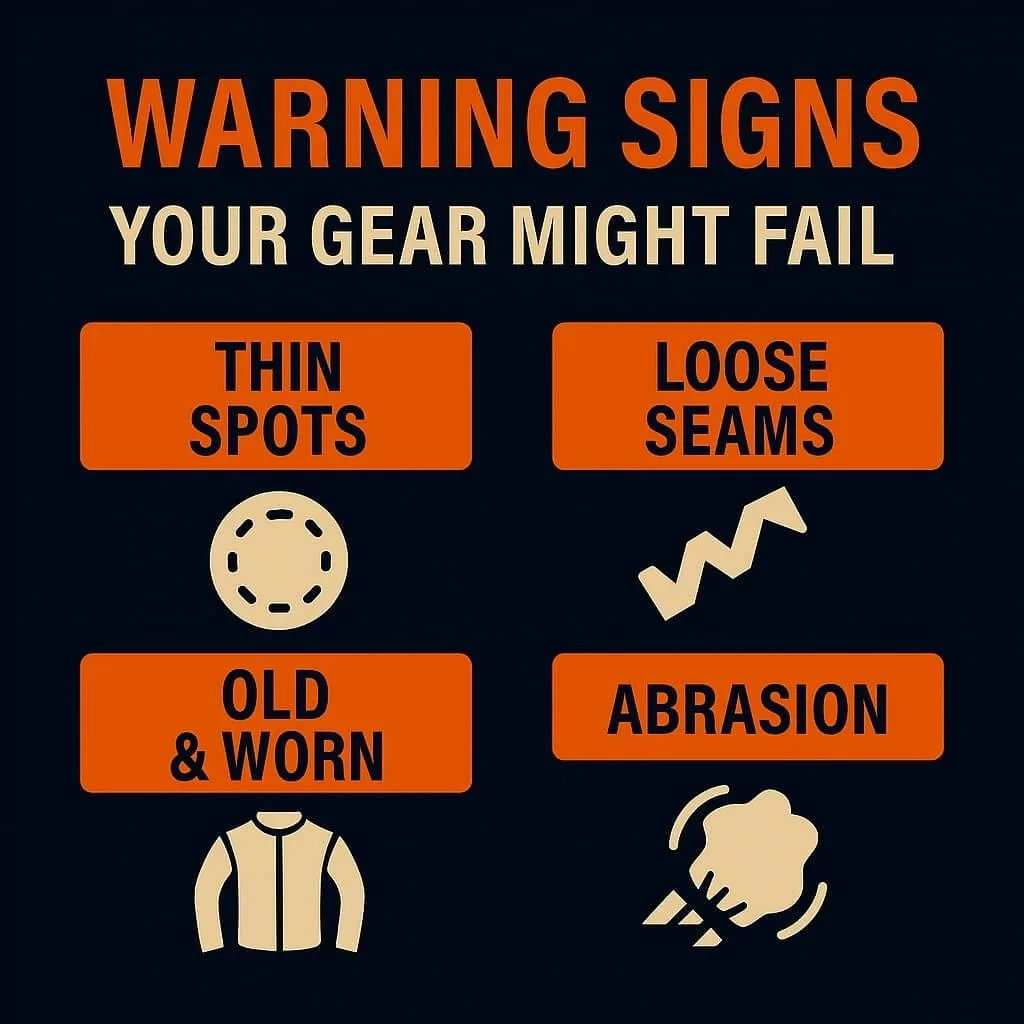
Warning Signs Your Gear Might Fail
You don’t need lab gear to spot trouble.
Before your next ride, check your suit or jacket for these warning signs:
Loose armor that shifts away from elbows or knees when you move
Single stitching in high-stress areas like the seat, shoulders, and thighs
Very thin “leather” that feels like plastic or flakes when scratched
Baggy fit with folds that can twist and catch during a slide
Cracked leather, popped seams, or torn lining
If you see more than one of these, it’s time to retire or upgrade that gear.
Waiting until after a crash is a painful way to learn.
How to Choose Gear That Survives a Crash
The good news: you don’t need to be a pro to get serious protection.
You just need to know what to look for.
1. Start with the right category
If you ride fast, tour long distances, or do track days, street-fashion jackets are not enough.
Look at proper performance and race gear.
A solid starting point is:
This type of gear is built with crash survival as the first goal.
2. Check for CE armor and how it sits
Look for CE-marked armor, ideally Level 2, in:
Shoulders
Elbows
Hips
Knees
Back
Then wear the jacket or suit and move into a riding position.
The armor should still sit over the joints, not above or below them.
3. Examine leather thickness and stitching
Race-grade leather usually measures around 1.2–1.4 mm thick.
Check seams in the seat, thighs, and shoulders.
You want strong double or triple stitching, not a single fragile thread line.
4. Make sure the pattern fits your riding posture
Your gear should feel snug and secure when you sit or tuck as you do on the bike.
Extra loose fabric or big folds are danger zones in a crash.
and pants sets built to zip together, like many in:
MotoSpeeds Motorcycle Matching Gear, help reduce gaps and keep everything locked in place.
5. Learn from other riders’ crashes
Reviews, forum posts, and real crash reports are gold.
Look for phrases like “saved my skin” or “held up great in a slide.”
Real-world feedback often reveals more than glossy product pictures.
MotoSpeeds Gear and Real-World Crash Protection
At MotoSpeeds, the idea is simple:
Build gear you never have to worry about — until the day it matters most.
That’s why the Performance Motorcycle Gear range uses:
Strong shells
CE-certified armor
Reinforced seams
Race-focused patterns
The Motorcycle Matching Gear collection is designed as a full system too:
Jacket, pants, gloves, and sometimes boots that work together.
This helps you keep consistent motorcycle crash protection from neck to ankles.
No weak links.
No exposed gaps at the waist or wrists.
Conclusion
When motorcycle gear fails, it fails quickly.
Seams pop, leather tears, armor shifts, and the road claims what the gear should have absorbed.
But you’re not powerless.
By understanding motorcycle crash protection, abrasion tests, leather failure points, and real accident outcomes, you can choose better gear before anything happens.
Next time you suit up, ask yourself:
“Would I trust this at 80 km/h on my side?”
If the answer feels shaky, listen to that feeling.
Upgrade before the road gives you a lesson you never wanted.
start with serious, track-ready options from:
MotoSpeeds Performance Motorcycle Gear
FAQs
Q1: What is the most common failure point in motorcycle gear?
A: Seams in high-stress zones like the seat, outer thigh, and shoulders. Poor stitching or bad seam placement often causes panels to split open during a slide.
Q2: Is textile gear as safe as leather in a crash?
A: High-end textile gear can perform well, but quality leather still gives the best slide time and tear resistance at higher speeds. Construction and fit matter more than material alone.
Q3: How often should I replace my riding suit after a crash?
A: After any serious crash, have the suit inspected by a professional. If seams have torn, leather has worn through, or armor has cracked, repair or replace it before riding again.
Q4: Can cheap leather gear ever be safe?
A: Very cheap leather often cuts corners on thickness, stitching, and armor quality. It may be better than riding in jeans, but it rarely equals a properly built race suit from a trusted brand.
Q5: What should I upgrade first if my budget is limited?
A: Start with a safe helmet and a strong jacket or one-piece suit with CE armor in key zones. Then add proper gloves, boots, and pants over time. Aim for a complete protection system.
Q6: Does matching gear really matter for safety?
A: Matching sets are often designed to connect and cover gaps, especially at the waist. That helps keep armor in place and reduces exposed skin during a crash.